
TL;DR:
- Active recall involves intentionally retrieving information from memory without notes, leading to stronger long-term retention. When combined with spaced repetition, it creates an efficient study system that prevents forgetting and enhances exam performance. Students often make mistakes like rereading instead of retrieving and skipping answer checks, which hinder effective learning.
Active recall is defined as the deliberate practice of retrieving information from memory without looking at notes or textbooks. It is the most effective study technique available, outperforming rereading, highlighting, and summarising for long-term retention. Tools such as flashcards, the Feynman technique, and practice tests all apply this principle. Research by cognitive scientists including Henry Roediger and Jeffrey Karpicke confirms that forcing your brain to retrieve knowledge strengthens memory far more than passive review ever can.
What is active recall and why does it work?
Active recall is retrieving information from memory without looking at your source material. The key difference from passive study is that you are producing knowledge rather than recognising it. Rereading a page of notes feels productive, but it only trains recognition. Exams, however, demand production. That gap explains why so many students feel prepared yet blank out on test day.

The science is straightforward. Every time you successfully retrieve a piece of information, the neural pathway connected to that memory grows stronger. Repeated retrieval makes that pathway faster and more reliable. This is why active recall produces up to 50–80% recall after one week, compared to just 30–40% with rereading. That difference compounds over a full academic term.
A key concept here is desirable difficulty. Retrieval feels harder than rereading because it genuinely is harder. That mental effort is not a sign that something is wrong. It is the mechanism by which deep learning occurs. The greater the effort to recall, the stronger the resulting memory trace.
Pro Tip: When a question feels difficult to answer from memory, resist the urge to check your notes immediately. Sit with the struggle for 30–60 seconds first. That effort is doing the work.
What are the best active recall techniques?
Students have several reliable methods to choose from. Each one forces retrieval rather than recognition, and each suits different subjects and learning styles.
-
Flashcards with spaced repetition. Write a question on one side and the answer on the other. Flashcards combined with spaced repetition systems naturally support active recall and efficient review. Digital apps such as Anki and Quizlet automate the scheduling of card reviews.
-
The blank page method. Close your notes and write down everything you can remember about a topic on a blank sheet of paper. This is the most reliable way to break the illusion of competence because it forces pure retrieval with no visual cues to trigger recognition.
-
Self-quizzing. After reading a chapter, close the book and answer questions about it from memory. Past exam papers from the Singapore Examinations and Assessment Board (SEAB) are ideal for this. They replicate the exact conditions of the real test.
-
The Feynman technique. Explain a concept aloud as if you are teaching it to someone who knows nothing about it. Any gap in your explanation reveals a gap in your understanding, which you can then address directly.
-
Practice tests. Timed mock papers under exam conditions combine retrieval with performance pressure, making them one of the most powerful active recall examples available to students.
Pro Tip: Always check your answers immediately after a retrieval attempt. Failing to check allows errors to become learned as facts, which is far harder to correct later.
How does active recall combine with spaced repetition?
Active recall tells you how to study. Spaced repetition tells you when to study. Together, they form the most efficient revision system available to students.
The forgetting curve, first described by Hermann Ebbinghaus, shows that memory fades rapidly after initial learning. Without review, most students forget roughly 70% of new material within 24 hours. Spacing out retrieval sessions at increasing intervals directly prevents this forgetting curve and improves academic performance significantly. If you are concerned about a child falling behind in studies, inconsistent review schedules are often a primary cause.
The practical approach is simple. After learning new material, attempt retrieval the same day. Review again after two days, then after five days, then after two weeks. Each successful retrieval resets the forgetting clock and extends the interval before the next review is needed. Apps such as Anki automate this scheduling entirely.
| Study Method | Retention After 1 Week | Effort Required | Best Use Case |
|---|---|---|---|
| Rereading | 30–40% | Low | Initial exposure only |
| Highlighting | Similar to rereading | Very low | Not recommended alone |
| Active recall | 50–80% | High | All subjects, all levels |
| Active recall + spaced repetition | Highest available | Moderate (with apps) | Long-term exam preparation |
For students preparing for the PSLE, O Levels, or A Levels, combining these two methods is the most time-efficient revision strategy available. The IB exam preparation community has adopted this pairing as standard practice for good reason.
What mistakes do students make with active recall?
Most students who try active recall give up too quickly or apply it incorrectly. These are the most common errors.
- Rereading instead of retrieving. Rereading trains recognition, not production. Students who reread feel familiar with the material but cannot produce it under exam conditions. Familiarity is not mastery.
- Mistaking difficulty for failure. When retrieval feels hard, many students assume they do not know the material and switch back to passive review. The difficulty is the learning. Giving up at this point discards the most valuable part of the process.
- Skipping answer checks. Retrieving an answer and moving on without checking it is a significant error. Even unsuccessful retrieval attempts strengthen memory once corrected. Without correction, wrong answers become reinforced.
- Using passive methods as warm-up. Spending 40 minutes rereading before attempting recall wastes the session. Start with retrieval from the first minute, then use your notes to correct gaps.
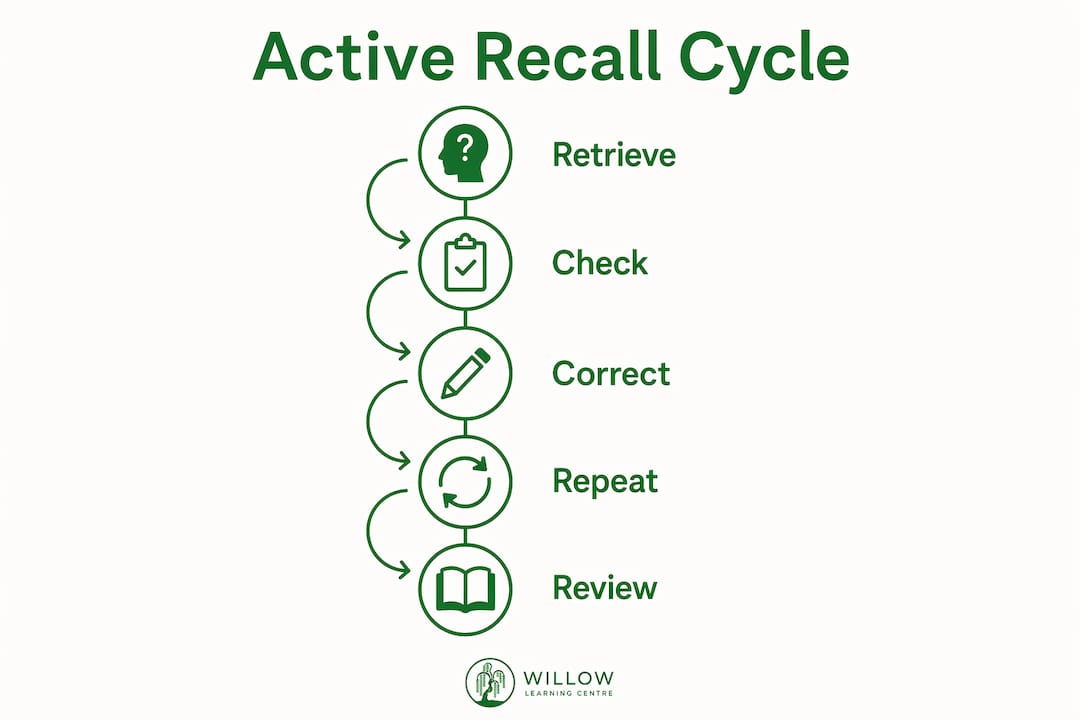
Pro Tip: Treat every study session as a cycle: retrieve, compare, correct, and repeat. This four-step loop is how durable learning is built and how errors are prevented from becoming permanent.
Key takeaways
Active recall is the single most research-backed study method available, and combining it with spaced repetition produces the strongest long-term retention of any revision approach.
| Point | Details |
|---|---|
| Active recall defined | Retrieving information from memory without notes, not recognising it from a page. |
| Retention advantage | Active recall produces 50–80% recall after one week versus 30–40% with rereading. |
| Best techniques | Flashcards, blank page method, self-quizzing, Feynman technique, and practice tests. |
| Spaced repetition pairing | Scheduling retrieval at increasing intervals prevents forgetting and locks in long-term memory. |
| Biggest mistake | Skipping answer checks after retrieval allows errors to become ingrained as false knowledge. |
Why i think most students are studying backwards
I have worked with hundreds of students across Primary, Secondary, and Junior College levels. The single most consistent pattern I see is this: students spend 80% of their study time on input and almost none on output. They read, highlight, and rewatch lecture recordings. Then they are genuinely surprised when they cannot answer questions under exam conditions.
The research is not ambiguous on this point. Retrieval practice produces 2–3 times better retention for the same study time as passive review. That is not a marginal improvement. It is the difference between a B3 and an A2.
What I tell students at Willow Learning Centre @ Bedok is this: the discomfort you feel when you cannot remember something is not a problem. It is the process working. Lean into it. Parents can support this by asking their children to explain topics aloud at the dinner table rather than asking whether they have finished their notes. That one shift in habit builds retrieval practice into daily life without adding a single extra hour of study.
The students who improve fastest are not the ones who study longest. They are the ones who spend the most time retrieving rather than reviewing. That is the whole insight. Apply it consistently and the results follow.
— Fu Pincheng
Build these habits with expert guidance at willow learning centre @ bedok
Understanding active recall is one thing. Applying it consistently under exam pressure is another. At Willow Learning Centre @ Bedok, our tutors build retrieval practice and spaced review directly into every small-group session, so students practise the right habits from day one.
Every student receives a personalised study plan tailored to their subject needs and exam timeline. Whether your child is preparing for the PSLE, O Levels, or A Levels, our tutors know exactly how to structure sessions for maximum retention. Visit Willow Learning Centre @ Bedok to find out how we can help your child study smarter and achieve the grades they are capable of.
FAQ
What is active recall in simple terms?
Active recall is the practice of retrieving information from memory without looking at your notes. It forces your brain to produce knowledge rather than simply recognise it from a page.
How does active recall differ from rereading?
Rereading trains recognition, which uses different neural pathways from the recall required in exams. Active recall trains production, which is the skill actually tested under exam conditions.
What are the easiest active recall examples to start with?
Flashcards and the blank page method are the simplest starting points. Close your notes, write down everything you remember about a topic, then check your notes to correct any gaps.
What is spaced repetition and how does it relate to active recall?
Spaced repetition is the practice of reviewing material at increasing intervals to prevent forgetting. Combining it with active recall produces the highest retention rates of any study method available.
How long before results improve with active recall?
Most students notice improved recall within two to three weeks of consistent practice. The key is applying retrieval from the start of every session rather than saving it for the end.