
Asking better questions in class is the single most effective skill a student can develop to deepen understanding and build stronger communication with teachers. The formal term for this practice is student inquiry, and research from the NSW Department of Education confirms that effective questioning is a planned, purposeful strategy, not a spontaneous act. For parents and students in Singapore navigating competitive academic environments, mastering this skill pays dividends far beyond any single lesson. The Question Formulation Technique (QFT) and wait time research both offer proven frameworks to get started.
What makes a question effective when asking teachers in class?
Effective questions share four qualities: they align with the lesson’s learning objective, they use clear language, they operate at the right level of cognitive challenge, and they carry a defined purpose. Without these qualities, even a well-intentioned question produces a shallow answer.
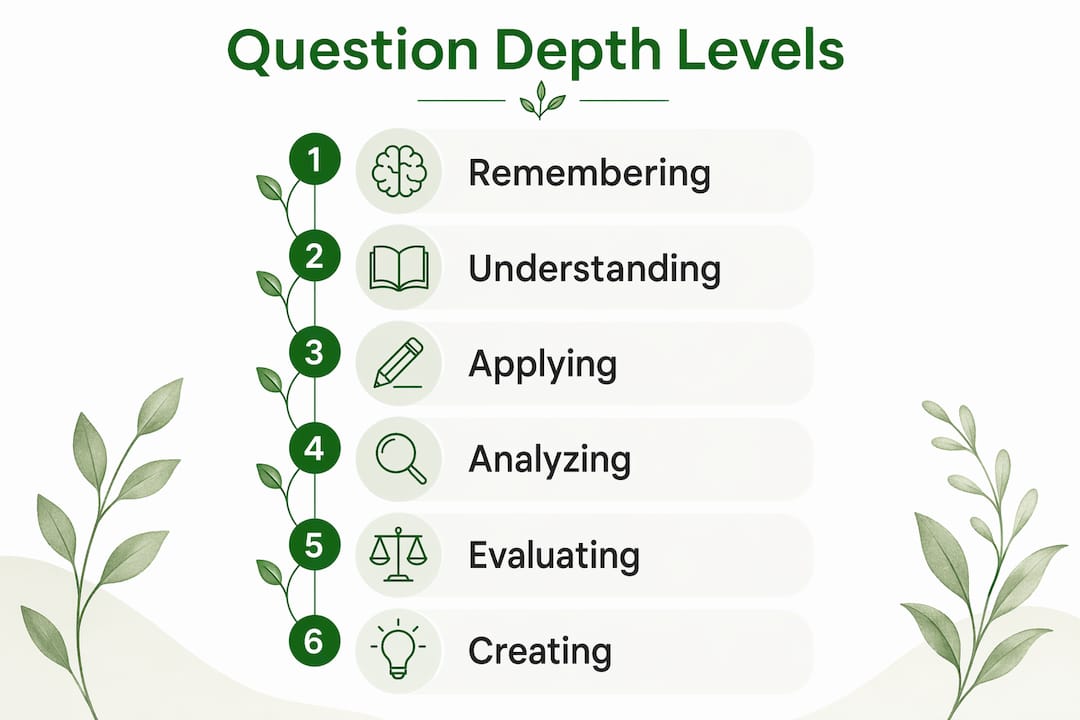
The most useful framework for understanding question depth is Bloom’s Taxonomy, which organises thinking into six levels: remembering, understanding, applying, analysing, evaluating, and creating. Most students default to the lowest two levels, asking recall questions such as “What is the formula?” or “What happened next?” These questions confirm facts but do not build understanding. A question at the analysis level, such as “Why does this method work here but not in the previous example?”, forces both student and teacher into a richer conversation.
Clarity and challenge balance are equally critical. A question that uses vocabulary the student does not yet own confuses rather than clarifies. The goal is to phrase questions at the edge of your current understanding, not beyond it.
The purpose behind a question matters as much as its wording. David Didau’s principles for effective questioning distinguish between questions that seek reasoning, questions that seek clarification, and questions that explore new territory. Deciding which type you need before you speak sharpens the question considerably.
-
Recall questions confirm facts: “What is the definition of osmosis?”
-
Clarification questions resolve confusion: “Can you explain why we use this formula and not the other one?”
-
Reasoning questions probe logic: “What would change if we altered this variable?”
-
Exploration questions open new ground: “How does this concept connect to what we studied last week?”
Pro Tip: Before raising your hand, spend five seconds deciding which of these four types your question belongs to. That single habit shifts the quality of your question immediately.
How can students prepare and phrase questions for better classroom engagement?
Preparation is the difference between a question that generates a useful answer and one that wastes everyone’s time. The Question Formulation Technique, developed by the Right Question Institute, provides a structured process: generate questions freely without judgement, categorise them as open or closed, prioritise the three most important ones, and reflect on what you learned from the process itself. Studies show QFT supports deeper engagement and better question quality among students at all levels.

The key insight from QFT is that structured question formulation produces repeatable results, whereas hoping curiosity strikes spontaneously does not. Parents can use this process at home before a school day, spending ten minutes with their child reviewing the upcoming lesson topics and generating a short list of focused questions.
Here is a practical preparation routine for students and parents:
-
Review the lesson topic the evening before. Identify one concept you understand and one you do not. The gap between them is where your best question lives.
-
Write the question down in one sentence. If you cannot write it in one sentence, it is not focused enough yet.
-
Convert it from closed to open. “Is this correct?” becomes “What would make this approach incorrect, and why?”
-
Check the purpose. Ask yourself: am I seeking clarification, reasoning, or exploration? Adjust the wording accordingly.
-
Choose the right moment. During a natural pause in the lesson, after the teacher has finished explaining a concept, is almost always better than interrupting mid-explanation.
For parents approaching teachers directly, focused 15-minute conversations with a prepared question list produce far more useful guidance than open-ended check-ins. Teachers respond better when they know the conversation has a defined scope and a clear purpose.
Pro Tip: Keep a small notebook or notes app open during class. Jot down questions as they arise rather than trying to hold them in memory. You will ask better questions and forget fewer of them.
How does wait time influence question quality in the classroom?
Wait time is defined as the period of silence a teacher or student maintains after asking a question, before anyone speaks. Research identifies two types: Type 1 wait time occurs after the teacher poses a question, and Type 2 wait time occurs after a student responds, before the teacher replies.
The evidence on wait time is striking. Most teachers wait less than one second before calling on a student or rephrasing the question. Yet extending that silence to three seconds or more produces measurably better outcomes. Tobin’s 1987 research, summarized by SecEd, shows that longer wait times encourage higher-order thinking, greater vocabulary use, and more voluntary contributions from students who would otherwise stay silent.
| Wait time duration | Typical student response |
|---|---|
| Under 1 second | Short, factual, low-confidence answers |
| 1 to 3 seconds | Slightly longer answers, still mostly recall |
| 3 to 5 seconds | More complex reasoning, greater accuracy |
| Over 5 seconds | Higher-order analysis, increased voluntary participation |
For students, the practical implication is this: when a teacher pauses after your question, that silence is thinking time, not disinterest. Resist the urge to rephrase or withdraw the question. The pause is the teacher processing and formulating a considered answer.
Students can also use wait time strategically themselves. After asking a question, count silently to three before adding any clarification. This signals confidence and gives the teacher space to respond fully. The main barrier to better questioning is almost always insufficient patience with silence, on both sides of the conversation.
What are common mistakes to avoid when questioning teachers?
The most frequent error students make is asking only recall questions. Recall questions confirm whether you have memorized something, but they do not help you understand it. If every question you ask in class begins with “What is…” or “Who was…”, you are operating at the bottom of Bloom’s Taxonomy and missing the deeper learning available to you.
A second common mistake is demanding an immediate answer without allowing thinking time. This happens when students ask a question and then immediately follow it with “…so is it X or Y?” The multiple-choice framing removes the teacher’s ability to guide you toward reasoning and replaces it with a coin flip.
Avoiding vague questions is equally important. “I don’t understand this chapter” is not a question. “I understand the first two steps of this process but I cannot see why step three produces a different result” is a question. The more precisely you identify the boundary of your confusion, the more precisely the teacher can address it.
“The quality of the answer you receive is almost entirely determined by the quality of the question you ask.” This principle, drawn from classroom research on metacognitive prompts, applies as much to student-teacher dialogue as it does to any other form of inquiry.
Two further pitfalls to avoid:
-
Trying to cover too many topics in one exchange. Pick one concept per question. If you have three questions, ask them separately and allow each answer to settle before moving on.
-
Relying on the “any questions?” prompt. This generic closing rarely produces good questions because it offers no focus. Prepare your question before the lesson ends so you are not scrambling when that moment arrives.
How can you build habits to keep improving your classroom questioning?
Improving the quality of questions you ask teachers is not a one-time fix. It is a habit built through reflection, iteration, and deliberate practice. The most effective approach combines short preparation routines with periodic review of what is and is not working.
-
Keep a question log. After each lesson, write down the questions you asked and the answers you received. Review the log weekly to identify patterns. Are you asking mostly recall questions? Are your questions getting more specific over time?
-
Conduct a monthly question audit. Using Bloom’s Taxonomy as a reference, code your questions by cognitive level and count how many fall into each category. This replaces guesswork with a concrete picture of your progress.
-
Request a focused teacher session. Once per term, schedule a 15-minute conversation with your teacher with a prepared list of three to five specific questions. This signals respect for their time and produces far more useful guidance than ad hoc corridor conversations.
-
Iterate based on feedback. If a teacher redirects your question or asks you to clarify, treat that as data. Adjust your phrasing for next time rather than repeating the same approach.
| Habit | Frequency | Purpose |
|---|---|---|
| Question log | After every lesson | Track patterns and identify gaps |
| Bloom’s taxonomy audit | Monthly | Replace intuition with measurable progress |
| Focused teacher session | Once per term | Obtain specific, actionable guidance |
| QFT preparation routine | Before each lesson | Generate focused, purposeful questions |
Parents play a significant role here. Coaching children to reflect on the questions they asked that day, rather than only the answers they received, builds the metacognitive habit that sustains long-term improvement.
Key takeaways
Asking better questions in class requires preparation, purposeful phrasing, patience with silence, and a habit of reflection built over time.
| Point | Details |
|---|---|
| Question purpose matters | Decide before speaking whether you need clarification, reasoning, or exploration. |
| Use the QFT process | Generate, categorize, and prioritize questions before class for consistently better results. |
| Wait time changes outcomes | Three or more seconds of silence after a question produces longer, more accurate answers. |
| Avoid recall-only questions | Move up Bloom’s Taxonomy to analysis and reasoning questions for deeper learning. |
| Build a reflection habit | Keep a question log and conduct monthly audits to track and improve question quality over time. |
Why questioning is the skill I wish every student in Singapore prioritised
I have worked with students across Primary, Secondary, and Junior College levels for years, and the pattern is consistent. The students who make the fastest progress are rarely the ones who study the longest. They are the ones who ask the sharpest questions. Not because they are naturally gifted at it, but because they have learned to treat questioning as a craft worth practising.
What surprises most parents is that this is not about being bold or outspoken in class. Some of the best questioners I have seen are quiet students who prepare two or three precise questions before each lesson and ask them at exactly the right moment. The teacher notices. The quality of the feedback they receive is noticeably different from what their peers get.
The mindset shift that matters most is moving from questioning as interrogation to questioning as collaboration. When a student approaches a teacher with “I understand X but I cannot connect it to Y, can you help me see the link?”, the teacher is not being tested. They are being invited into a genuine learning conversation. That invitation changes the entire dynamic of the interaction.
My advice to parents is to coach this skill at home, not just encourage it in the abstract. Ask your child what questions they plan to ask tomorrow. Review their question log with them. Treat it with the same seriousness you give to revision schedules and exam preparation. The return on that investment is real and lasting.
— Pincheng
How Willow Learning Centre supports students in developing this skill
Students who learn to ask better questions in class do not develop that skill in isolation. They need guided practice, feedback, and a learning environment that models the kind of purposeful inquiry described in this article.
At Willow Learning Centre, small group tuition classes for Primary, Secondary, and Junior College students in Singapore are designed around exactly this approach. Tutors work with each student individually to build critical thinking habits, refine how they frame questions, and develop the confidence to engage teachers meaningfully. If you want your child to walk into every lesson prepared to ask the questions that actually move their learning forward, explore how personalized tuition at Willow Learning Centre can support that goal.
FAQ
What is the Question Formulation Technique?
The Question Formulation Technique (QFT) is a structured process developed by the Right Question Institute in which students generate, categorize, and prioritize their own questions. Research shows it improves question quality, creativity, and classroom engagement.
How long should wait time be after asking a question?
Wait time of three to five seconds after asking a question produces significantly better responses, including more complex reasoning and greater accuracy. Most teachers and students wait less than one second, which limits the depth of the answer.
What types of questions should students avoid asking teachers?
Students should avoid purely recall-based questions, vague requests such as “I don’t understand this”, and multi-part questions that cover too many topics at once. Specific, single-focus questions at the analysis or reasoning level produce the most useful teacher responses.
How can parents help their children ask better questions in class?
Parents can use the QFT process at home before school days, review their child’s question log weekly, and coach them to identify the purpose of each question before asking it. Scheduling a focused 15-minute session with the teacher once per term also produces more actionable guidance.
How does Bloom’s Taxonomy help students improve their questions?
Bloom’s Taxonomy organizes thinking into six levels from recall to creation. Students who use it as a reference can deliberately move their questions from low-level recall to higher-level analysis and reasoning, which deepens both the conversation and their own understanding.