TL;DR:
- A child's persistent academic struggles often result from weak foundational skills, emotional challenges, or environmental pressures, rather than lack of effort or intelligence. Addressing these root causes through targeted interventions and early assessments improves long-term confidence and progress. Recognising early signs and collaborating with professionals or supportive centres can prevent ongoing decline and emotional distress.
A child falling behind in studies is defined as a persistent mismatch between their current skills and what the curriculum demands of them. This is not a reflection of intelligence or effort. Academic struggles stem from systemic issues: weak foundational learning skills, emotional challenges such as anxiety or depression, and environmental pressures that quietly erode a child's capacity to keep up. If you are asking why is my child falling behind in studies, the answer almost always lies in one of these three areas, and identifying which one is the first step towards real progress.
Why is my child falling behind in studies?
Approximately 30% of children struggle academically not because they lack intelligence, but because their underlying brain-based learning skills are underdeveloped. This means that roughly one in three children sitting in a Singapore classroom today may be working far harder than their peers just to keep pace, yet still falling short. The gap between understanding something with a teacher's guidance and executing it independently at home is where many children first show signs of difficulty.
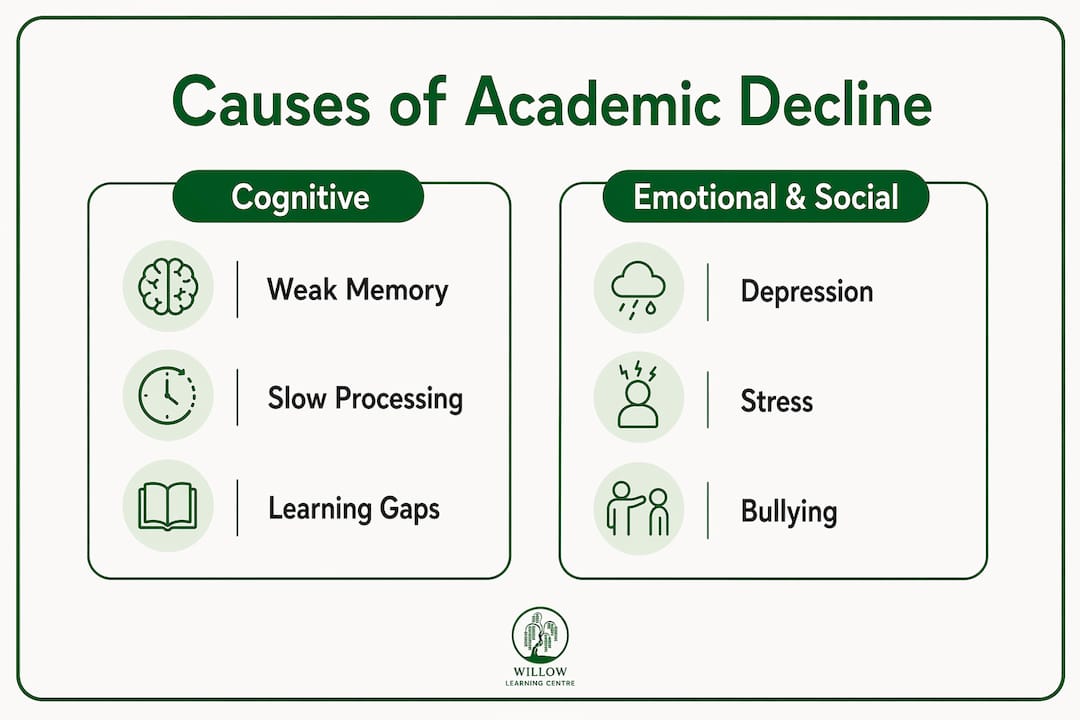
Working memory and processing speed are two of the most critical cognitive skills for academic success. Working memory allows a child to hold instructions in mind while completing a task. Processing speed determines how quickly they can absorb and respond to new information. When either is weak, classroom tasks that appear manageable become exhausting, and homework becomes a battleground.
Children with weak working memory often meltdown or disengage not from lack of ability, but from genuine cognitive overload. This distinction matters enormously. A child who forgets multi-step instructions, frequently guesses at answers, or collapses emotionally over homework is not being difficult. They are signalling a structural gap in their learning toolkit.
Pro Tip: If your child understands a topic when you explain it but cannot reproduce the work independently the next day, this is a classic indicator of weak working memory rather than a motivation problem.
| Learning skill | Academic impact |
|---|---|
| Working memory | Difficulty following multi-step instructions and retaining lesson content |
| Processing speed | Slow written output, struggles to complete timed tasks or tests |
| Phonological awareness | Weak reading fluency and spelling accuracy |
| Attention and focus | Inconsistent performance, frequent careless errors |
| Visual-spatial processing | Difficulty with geometry, graphs, and written organisation |
How do emotional and psychological factors cause academic decline?
Depression is a primary predictor of motivational loss and disengagement from studies, with higher depression levels statistically linked to a loss of intrinsic interest in learning. For parents, this is a critical finding. A child who appears lazy or indifferent may be experiencing a genuine psychological shift that no amount of extra tuition will fix without addressing the root cause.
Academic burnout is a related but distinct issue. It develops when prolonged pressure exceeds a child's capacity to recover. The signs are often subtle and easy to misread as attitude problems.
Signs of emotional overload and burnout to watch for include:
- Persistent irritability or emotional withdrawal, particularly around school topics
- Avoidance behaviours such as repeatedly "forgetting" homework or feigning illness
- Loss of interest in subjects or activities the child previously enjoyed
- Physical symptoms such as headaches or stomachaches that cluster on school mornings
- Difficulty sleeping or changes in appetite linked to school-related anxiety
- Crying or emotional outbursts that seem disproportionate to the task at hand
These somatic complaints signal depleted stress buffers, not random fatigue. A child whose stomach hurts every Monday morning is communicating something important about their emotional state.
Pro Tip: Watch for behavioural changes that appear gradually over weeks rather than sudden outbursts. Children rarely ask for help overtly; they speak through withdrawal and irritability instead.
Clinicians recommend that mood-related changes persisting for two weeks or longer warrant a conversation with a professional. Learning difficulties that persist for six months signal the need for a formal assessment. These thresholds exist because early identification consistently leads to better outcomes.
What environmental and social factors affect a child's learning?
External pressures are often the invisible weight behind a child's academic struggles. Social stress, including bullying or social exclusion, redirects a child's mental energy away from learning entirely. A child preoccupied with whether they will be left out at recess cannot fully engage with a mathematics lesson.

Family conflict, grief, or significant life transitions such as moving home or parental separation affect concentration and emotional stamina in measurable ways. Poor sleep compounds every other difficulty. A child who is not sleeping well will show increased distractibility, weaker emotional regulation, and reduced capacity to retain new information, all of which look like academic disengagement from the outside.
| Environmental factor | Potential academic consequence |
|---|---|
| Bullying or social exclusion | Reduced concentration, school avoidance, anxiety |
| Family conflict or grief | Emotional withdrawal, inconsistent performance |
| Poor sleep quality | Distractibility, memory difficulties, emotional dysregulation |
| Health issues or chronic fatigue | Slow written output, meltdowns, apparent lack of effort |
| Transition to independent work | Sudden drop in grades when classroom scaffolding is removed |
The transition from a supported classroom environment to independent work is a particularly common trigger for academic decline in Singapore's Primary 3 and Secondary 1 years. At these stages, the curriculum demands shift sharply, and children who relied on structured teacher support suddenly need to self-regulate their learning. Those without strong foundational skills hit a wall at precisely this point.
What are the signs my child is truly falling behind?
Temporary dips in performance are normal. Every child has off weeks, particularly around major transitions or examinations. The concern arises when difficulties are sustained, worsening, or accompanied by emotional distress. Early parental recognition of subtle signs and timely intervention prevent worsening of academic decline and emotional distress, yet most parents wait too long before acting.
Signs that suggest a child is genuinely falling behind rather than having a temporary dip:
- A noticeable gap between how well they speak about a topic versus how they perform in writing
- Repeated notes from teachers about attention, effort, or incomplete work
- Extreme distress around homework that is disproportionate to the difficulty of the task
- Slow progress despite consistent effort over several weeks
- Avoidance of reading, writing, or specific subjects that were previously manageable
- Persistent behaviour problems lasting two weeks (emotional) or six months (learning) warrant professional assessment
The distinction between a motivation problem and an underlying learning challenge is not always obvious. A child who avoids work is not necessarily unmotivated. They may have learned that effort leads to failure, and avoidance has become their coping strategy.
How can you help your child catch up and build confidence?
The most common mistake parents make is adding more study time without changing the approach. Focused interventions on skill-building are needed over increased practice alone. More of the same strategy that is not working will not produce different results.
Practical steps to support your child effectively:
- Identify the specific gap. Speak with your child's teacher to understand whether the difficulty is cognitive, emotional, or environmental before choosing a response.
- Prioritise emotional safety. A child who feels judged or pressured at home will not take academic risks. Regular, low-pressure conversations build the trust needed for honest communication. Understanding children's emotional regulation can help parents respond to meltdowns more effectively.
- Choose targeted support. Generic tuition that mirrors classroom teaching often fails children with foundational skill gaps. Look for personalised learning approaches that address the root cause rather than the symptom.
- Collaborate with teachers. Regular communication with your child's school ensures you are working from the same understanding of the problem.
- Seek professional assessment early. If difficulties persist beyond the clinical thresholds above, a psychoeducational assessment can identify specific learning profiles and guide targeted intervention.
Pro Tip: When evaluating tuition options, ask specifically how the centre identifies and addresses foundational skill gaps. A centre that cannot answer this question clearly is likely offering curriculum drilling rather than genuine learning support. Review common mistakes when choosing a tuition centre before committing.
Key takeaways
A child falling behind in studies is almost always experiencing a gap in foundational learning skills, emotional wellbeing, or environmental support, not a deficit in intelligence or effort.
| Point | Details |
|---|---|
| Cognitive skill gaps are common | Around 30% of children struggle due to weak working memory or processing speed, not low ability. |
| Emotional factors drive disengagement | Depression and burnout reduce intrinsic motivation and must be addressed alongside academic support. |
| Environment shapes performance | Bullying, poor sleep, and family stress each create measurable academic consequences. |
| Duration thresholds guide action | Emotional concerns lasting two weeks and learning difficulties lasting six months signal the need for assessment. |
| Targeted support outperforms drilling | Skill-building interventions produce better outcomes than simply increasing study hours. |
What I have learned from watching parents wait too long
Fu Pincheng here. After years of working with students across Singapore, the pattern I see most often is not a child who suddenly falls apart. It is a child who has been quietly struggling for months while their parents hoped things would improve on their own.
Parents are not to blame for this. The signals children send are genuinely easy to miss, and the school system rarely flags concerns until grades have already dropped significantly. What I have found, though, is that the parents who act on early, subtle observations consistently see better outcomes than those who wait for a formal warning.
The other misconception I encounter regularly is the belief that more effort is the answer. I have sat with children who are already working twice as hard as their classmates and still falling short. Telling that child to try harder is not just unhelpful. It is damaging. What they need is someone to identify why the effort is not translating into results, and then address that specific gap.
Trust your observations. If something feels off, it probably is. You do not need a failing grade to justify seeking support.
— Fu Pincheng
How Willow Learning Centre @ Bedok can help
If you recognise any of the signs described in this article, the next step is finding support that addresses the actual cause rather than adding more of what is not working.

Willow Learning Centre @ Bedok offers small group tuition for Primary, Secondary, and Junior College students across Singapore. Classes are built around each student's individual learning needs, not a one-size-fits-all curriculum. The tutors at Willow Learning Centre @ Bedok have a proven track record of helping students who struggle despite genuine effort, by identifying the specific gaps holding them back and building the skills needed to close them. If your child is working hard but not seeing results, this is exactly the kind of targeted support that makes the difference.
FAQ
Why is my child falling behind despite trying hard?
Hard work without the right foundational skills often produces frustration rather than progress. Weak working memory or processing speed can make academic tasks disproportionately difficult, meaning effort alone is not sufficient without targeted skill-building support.
What are the first signs my child is struggling academically?
Watch for a gap between verbal understanding and written performance, extreme distress over homework, avoidance of specific subjects, and repeated teacher comments about attention or incomplete work. These signs, sustained over several weeks, indicate a pattern rather than a temporary dip.
When should I seek professional help for my child's learning difficulties?
Clinicians recommend seeking assessment when emotional or behavioural concerns persist for two weeks, or when learning difficulties continue for six months despite support. Acting within these thresholds prevents further decline and emotional distress.
Is falling behind in school a sign of a learning disorder?
Not necessarily. Many children fall behind due to weak foundational cognitive skills, emotional stress, or environmental factors rather than a diagnosed learning disorder. A psychoeducational assessment can clarify the cause and guide the right intervention.
Does tuition help a child who is falling behind?
Tuition helps when it targets the specific gap causing the difficulty. Generic curriculum drilling is less effective for children with foundational skill weaknesses. Personalised tuition that identifies and addresses the root cause produces measurably better outcomes.