
TL;DR:
- Personalised learning tailors instruction and content to each student’s knowledge, boosting engagement and achievement. It emphasizes knowledge-level adaptation over learning styles, with AI supporting but not replacing teacher judgment. Implementing targeted enrichment for average students sustains academic growth and prevents stagnation.
Personalized learning is defined as the practice of tailoring instruction, pacing, and content to each student’s individual knowledge level, readiness, and motivational state. Research confirms this approach directly raises student engagement, metacognitive skill development, and long-term academic achievement. For educators and parents navigating Singapore’s competitive education system, understanding the importance of personalized education is not optional. It is the clearest path to helping students reach their potential.
A study of 1,589 children found that early personalized enrichment significantly increased high school graduation and college attendance rates. That finding alone reframes the conversation. Personalized learning is not a classroom luxury. It is a long-term investment in a student’s life trajectory.
Why personalized learning matters for students: what the research says
The empirical case for tailored learning is substantial and growing. Five global policy documents now cite improving learning outcomes as the top priority for personalized learning adoption across K-12 systems worldwide. This signals a global consensus that standard, one-size-fits-all instruction is no longer adequate.
The most significant recent finding concerns how personalization is applied. Research published in 2026 shows that knowledge-adaptive personalization produces a larger effect size (η²=0.21) on metacognitive skills than learning-style-based approaches (η²=0.12). Metacognition refers to a student’s ability to monitor and regulate their own thinking. Students with stronger metacognitive skills study more effectively, recover from setbacks faster, and perform better under exam pressure.
Key findings from recent research include:
-
Early personalized enrichment correlates with higher educational attainment across a student’s entire academic life.
-
Knowledge-level adaptation outperforms learning-style adaptation in developing critical thinking skills.
-
Global education policy now prioritizes personalized strategies as the primary lever for improving learning equity and outcomes.
-
Multiple studies link personalized learning environments to higher engagement, stronger digital literacy, and broader soft-skill development.
The implication is direct. When you adapt instruction to what a student already knows rather than how they prefer to receive information, the cognitive gains are measurably larger.
How does personalized learning improve student engagement and metacognition?
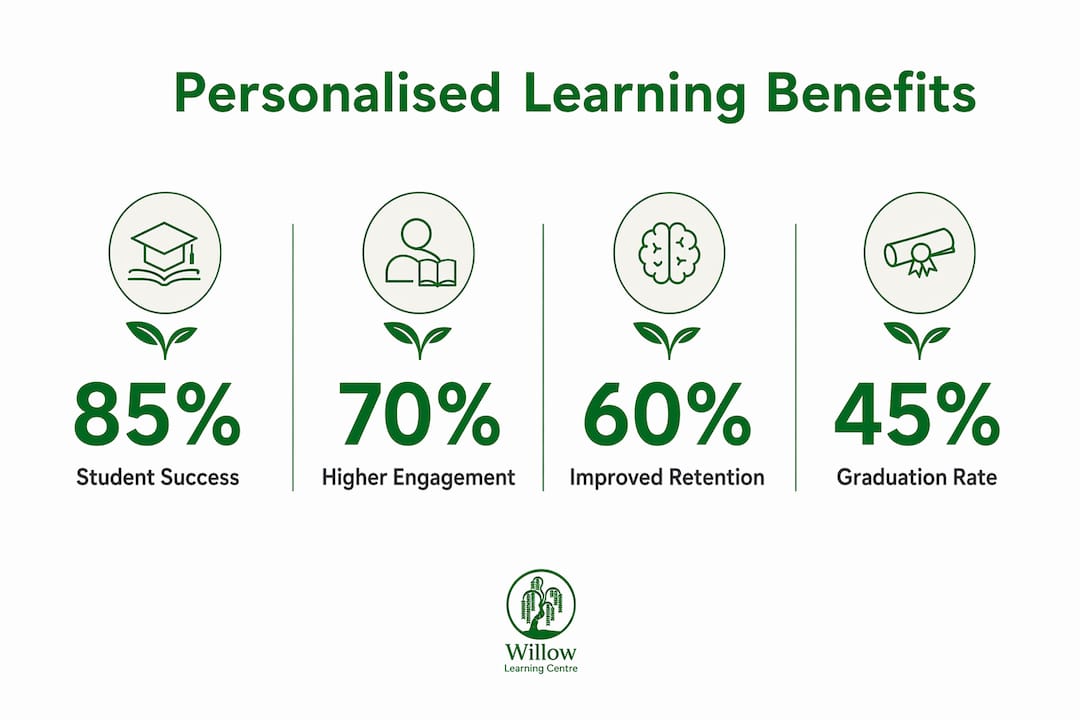
Engagement is not simply about a student paying attention in class. It encompasses motivation, self-regulation, and the willingness to persist through difficulty. Adaptive e-learning environments that prioritize knowledge-level adjustments over learning-style preferences produce deeper engagement and stronger metacognitive thinking. The reason is straightforward: when content is pitched at the right level of challenge, students experience neither boredom nor overwhelm.

The MAPLe-I framework, developed through 2026 research, demonstrates that mechanism-aware personalized learning improves both immediate and long-term outcomes by modelling a learner’s engagement state, readiness to self-regulate, and affective needs simultaneously. This is a more complete picture of the student than any single test score provides.
Practical implications for educators and parents include:
-
Observe whether a student is challenged at the right level, not just whether they are completing work.
-
Track patterns in effort and persistence, not only grades, as indicators of genuine engagement.
-
Recognize that a student who appears disengaged may simply be under-challenged rather than unmotivated.
Pro Tip: When reviewing your child’s progress, ask their tutor specifically about knowledge-level adjustments. A student who consistently scores well on easy material may need enrichment, not more of the same.
What role does AI play in personalized learning today?
Artificial intelligence has shifted from a supplementary tool to a core component of effective personalized learning. AI supports real-time instructional feedback, adaptive pacing, and differentiated content delivery in ways that a single teacher managing thirty students cannot replicate manually. Intelligent tutoring systems can identify gaps in a student’s knowledge within minutes and adjust the next task accordingly.
The process works in four stages:
-
Diagnostic assessment. The system analyses a student’s current knowledge state through initial tasks or tests.
-
Pathway generation. AI maps a learning sequence tailored to identified gaps and strengths.
-
Real-time adjustment. As the student works, the system recalibrates difficulty and content based on performance signals.
-
Teacher review. Educators interpret the data, provide socio-emotional support, and make pedagogical decisions the algorithm cannot.
“Personalized learning’s effectiveness is maximized when AI systems work in tandem with teachers who interpret data and provide socio-emotional support.” — Springer, 2026
The critical caveat is that AI carries real risks. Algorithmic bias and the erosion of human connection are documented concerns in AI-driven education. A system trained on narrow data sets may systematically underserve certain student groups. This is why teacher oversight is not optional. It is the ethical foundation of any AI-assisted learning environment. For a broader view of how AI transforms education, the opportunities are real but require careful, human-led implementation.
How can educators and parents apply personalized learning effectively?
Translating research into practice requires clarity about what personalization actually means in a classroom or home-study context. The table below contrasts two common approaches.
| Approach | What it focuses on | Evidence of effectiveness |
|---|---|---|
| Learning-style adaptation | Visual, auditory, or kinaesthetic preferences | Weak. Effect size η²=0.12 on metacognitive skills. |
| Knowledge-level adaptation | Student’s current understanding and readiness | Strong. Effect size η²=0.21 on metacognitive skills. |
The practical priority is clear. Focus on what a student knows and does not yet know, not on whether they prefer diagrams over text.
One group that deserves particular attention is what researchers call the “forgotten middle.” These are students who are managing adequately, passing assessments, and causing no concern. They are also the students most likely to plateau without enrichment. Personalized enrichment for advanced learners sustains academic momentum and builds the confidence needed for higher-level challenges.
Pro Tip: If your child is consistently scoring in the middle band, ask whether their programme includes enrichment tasks that stretch beyond the current syllabus. Adequate performance is not the same as realized potential.
For parents, the most effective step is choosing learning support that explicitly adapts to knowledge level. For educators, personalized learning strategies that incorporate scaffolded support and regular diagnostic checks produce the most consistent gains across diverse student groups.
Key takeaways
Personalized learning works because it adapts to what a student actually knows, not how they prefer to learn, producing measurably stronger cognitive and academic outcomes.
| Point | Details |
|---|---|
| Knowledge-level adaptation wins | Adapting to prior knowledge (η²=0.21) outperforms learning-style methods (η²=0.12) on metacognitive skill gains. |
| Early enrichment has lasting impact | Personalized learning in early years significantly raises high school graduation and college attendance rates. |
| AI needs human oversight | AI-driven tools improve pacing and feedback, but teacher involvement is required for ethical and contextual accuracy. |
| The forgotten middle needs enrichment | Students performing adequately still benefit from personalized challenge to sustain long-term academic momentum. |
| Engagement is measurable and teachable | Mechanism-aware models that address engagement, self-regulation, and affective state optimize both short and long-term outcomes. |
Why I think we are still underestimating personalized learning
After working closely with students across Secondary and Junior College levels, the pattern I see most often is not failure. It is stagnation. Students who are fine on paper but quietly disengaged, coasting on memorization rather than genuine understanding.
The research on knowledge-level adaptation confirms what good tutors have always known intuitively. Pitching content at the right level of challenge is the single most reliable way to keep a student genuinely thinking. Learning-style theory was appealing because it gave teachers a framework, but the evidence now shows it was the wrong framework.
What I find most compelling about the 2026 research is the MAPLe-I model’s insistence on addressing affective needs alongside cognitive ones. A student who is anxious about an upcoming exam is not in the same learning state as one who is confident. Treating them identically is not neutral. It is a missed opportunity.
The honest challenge for parents is that personalized learning requires someone who actually knows your child’s knowledge gaps, not just their grade. That requires consistent, attentive instruction over time. Technology can accelerate the diagnostic process, but it cannot replace the relationship between a student and a tutor who genuinely understands where they are stuck and why.
— Fu Pincheng
How Willow Learning Centre @ Bedok supports personalized student success
Willow Learning Centre @ Bedok applies the same evidence-based principles discussed in this article to every student it works with. Small group tuition classes for Primary, Secondary, and Junior College students are structured around each learner’s current knowledge level, not a generic syllabus pace. Tutors at Willow Learning Centre @ Bedok use diagnostic assessments to identify gaps, design tailored learning pathways, and adjust instruction as students progress. The result is the kind of targeted support that research consistently links to stronger grades and lasting academic confidence. If you want your child to benefit from personalized tutoring in Bedok, Willow Learning Centre @ Bedok is the practical next step.
FAQ
What is personalized learning in simple terms?
Personalized learning means adapting the content, pace, and support a student receives to match their current knowledge level and readiness. It is distinct from learning-style theory, which has weaker evidence behind it.
How does personalized learning help students academically?
Research shows that personalized enrichment from an early age significantly increases high school graduation and college attendance rates. Knowledge-level adaptation also produces stronger metacognitive skills, which improve performance across all subjects.
Is AI-based personalized learning safe for students?
AI tools can improve feedback and pacing, but they carry risks including algorithmic bias. Effective and ethical AI-assisted learning always involves teacher oversight to interpret data and provide human support.
What is the “forgotten middle” in personalized learning?
The forgotten middle refers to students who are performing adequately but not receiving enrichment beyond remedial support. These students benefit most from personalized challenge that builds on their existing strengths rather than simply addressing weaknesses.
How can parents support personalized learning at home?
Parents can ask tutors and teachers specifically about knowledge-level adjustments and whether enrichment tasks are included for students who are already meeting expectations. Choosing small-group tuition with diagnostic assessment is one of the most direct ways to apply personalized learning principles outside school.