
TL;DR:
- The Pomodoro Technique structures work into short, focused intervals to combat mental fatigue and procrastination. Research supports its effectiveness in improving focus, reducing fatigue, and increasing task performance by aligning with natural attention spans. Effectiveness depends on maintaining discipline, customizing interval lengths, and ensuring true disengagement during breaks.
The Pomodoro Technique is defined as a time management method that structures work into 25-minute focused intervals, called pomodoros, separated by short breaks. Francesco Cirillo developed it in the late 1980s using a tomato-shaped kitchen timer, which gave the method its name ("pomodoro" is Italian for tomato). Understanding how the Pomodoro Technique works matters because it directly addresses two of the biggest obstacles to productive study: mental fatigue and the urge to procrastinate. Apps like Forest, Be Focused, and Toggl Track have built entire products around this single framework, which tells you something about its staying power.
What are the pomodoro technique steps?
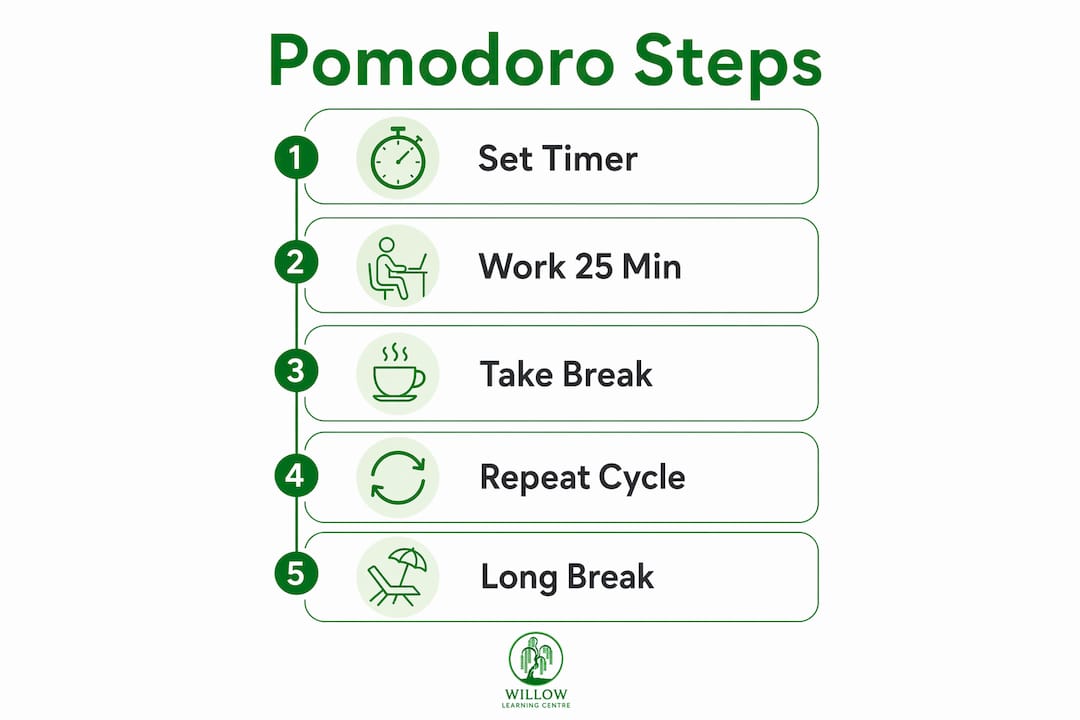
The classic Pomodoro protocol involves six steps that complete one full work cycle of roughly two hours. Each step is deliberate, and skipping any one of them weakens the whole system.
- Choose one task. Write it down before you start. Vague intentions produce vague results.
- Set a timer for 25 minutes. A physical timer works best, but apps like Be Focused or Forest are reliable alternatives.
- Work on that single task until the timer rings. No switching, no checking messages, no detours.
- Mark a tick on paper. Recording each completed interval builds an accurate picture of how long tasks actually take.
- Take a 5-minute break. Stand up, stretch, or look out a window. Do not open social media.
- After four pomodoros, take a longer break of 15–30 minutes. This is the recovery window that makes the next cycle possible.
The indivisibility rule is the most misunderstood part of the method. Pomodoros are indivisible: if an interruption forces you to stop, you must abandon that pomodoro entirely and restart it later. This sounds harsh, but it trains you to protect your focus window rather than treat it as negotiable.
Pro Tip: Write a brief "interruption inventory" during your break. When a distracting thought appears mid-pomodoro, jot it down on a notepad and return to it after the timer rings. This keeps your focus intact without losing the idea.

Does research actually support the pomodoro method?
The evidence is strong. A 2025 scoping review of 32 studies covering 5,270 participants found that structured Pomodoro-style intervals consistently improve focus, reduce mental fatigue, and enhance sustained task performance compared to self-paced work. That is not a small sample. It represents a broad cross-section of students, knowledge workers, and creative professionals.
The cognitive explanation centres on two well-documented phenomena. First, vigilance decrement begins between 20–40 minutes of sustained attention, which is precisely why the 25-minute interval sits where it does. Second, task switching consumes up to 40% of an individual's productive time. That figure from the American Psychological Association explains why bouncing between tasks feels exhausting even when you have not done much actual work.
"The Pomodoro Technique reduces the psychological barrier to starting by shrinking task scope to manageable 25-minute chunks." — TaskPomo Productivity Research
There is also the Zeigarnik effect at play. Your brain holds unfinished tasks in working memory, creating low-level anxiety. Committing to just 25 minutes lowers the activation energy needed to begin, because you are not promising yourself a marathon. You are promising yourself a sprint.
Pomodoro also provides more high-quality focus time by preventing the attention decline seen in long, uninterrupted sessions. The breaks are not wasted time. They are the mechanism that makes the next interval possible.
Pomodoro variations: when to adjust the intervals
The standard 25/5 split is not a law. It is a starting point. Knowing when to adapt it separates effective practitioners from frustrated ones.
| Variation | Work Interval | Break | Best For |
|---|---|---|---|
| Classic Pomodoro | 25 min | 5 min | General study, revision, writing |
| Extended Focus | 50 min | 10 min | Deep reading, problem sets |
| Short Sprint | 15 min | 5 min | Low-motivation days, new habits |
| Long Cycle | 90 min | 20 min | Creative or analytical flow work |
Creative or analytical work that requires deep flow may not fit a 25-minute timer, as it can interrupt peak focus phases. If you are writing an essay or solving complex mathematics, a 50/10 split often produces better results than resetting every 25 minutes.
Break quality matters as much as break length. 5-minute breaks are effective only if they involve true disengagement. Stretching, looking at a distant object, or a short walk outside all restore directed attention. Scrolling through Instagram does not. It simply replaces one cognitive demand with another.
Pro Tip: If you find yourself dreading the timer, shorten your intervals to 15 minutes for one week. The goal is to build the habit first, then extend the duration once the routine feels natural.
How to apply the pomodoro technique to study and work
Setting up correctly before you start a session determines whether the method holds. A clear workspace, a written task list, and a charged timer are the three non-negotiables.
- Prioritise your task list the night before. Decide which tasks deserve pomodoros tomorrow, and in what order. This removes decision fatigue from the morning.
- Use the interruption inventory technique. Keep a notepad beside your timer. When a thought or errand surfaces mid-session, write it down and return to it during a break.
- Match interval length to task complexity. Flashcard revision suits 25-minute blocks. A long-form essay may need 50-minute blocks. Adjust based on what the task demands, not what feels comfortable.
- Integrate with a task manager. Tools like Notion, Todoist, or a simple paper planner work well alongside Pomodoro timing. The timer handles when you work; the task manager handles what you work on.
- Track your pomodoros daily. Recording daily pomodoros combats the planning fallacy by giving you empirical data on how long tasks actually take. After two weeks, your estimates become noticeably more accurate.
Students preparing for major exams can pair this approach with exam stress management strategies to make study sessions both productive and sustainable. The two methods complement each other directly.
For students who want to apply this to assignment submission, breaking each stage of the submission process into timed intervals removes the overwhelm of treating an assignment as one enormous task.
Key takeaways
The Pomodoro Technique works because it aligns work intervals with natural attention limits, uses structured breaks to restore focus, and builds a measurable record of effort over time.
| Point | Details |
|---|---|
| Core interval is 25 minutes | Work in focused 25-minute blocks, then take a 5-minute break before repeating. |
| Pomodoros are indivisible | Interruptions require abandoning and restarting the interval to protect focus quality. |
| Research confirms effectiveness | A review of 32 studies with 5,270 participants found consistent focus and fatigue improvements. |
| Break quality determines recovery | Only true disengagement during breaks, such as stretching or walking, restores attention. |
| Tracking builds better planning | Recording completed pomodoros produces accurate effort estimates and reduces planning errors. |
Why pomodoro is really about emotional management
Fu Pincheng, Willow Learning Centre @ Bedok
Most people treat the Pomodoro Technique as a scheduling trick. I think that misses the point entirely. The real power of the method is emotional, not logistical.
When a student sits down to study for three hours, the size of that commitment triggers avoidance. The brain reads "three hours" as a threat. But "25 minutes" reads as survivable. That shift in perception is what gets people started, and starting is almost always the hardest part.
I have seen students at Willow Learning Centre @ Bedok transform their study habits not because they suddenly became more disciplined, but because the method made the first step feel small enough to take. The physical act of winding a mechanical timer reinforces this further. It is a behavioural signal that says: focus begins now.
The mistake most people make is treating the technique as rigid. If a 25-minute interval interrupts your flow on a good day, extend it. The framework exists to serve your focus, not the other way around. Pomodoro works best when you understand the principle behind it well enough to bend the rules intelligently.
— Fu Pincheng
Build better study habits with willow learning centre @ bedok
Time management techniques like the Pomodoro method are most effective when they are part of a broader, personalised learning plan.

Willow Learning Centre @ Bedok offers small group tuition for Primary, Secondary, and Junior College students across Singapore. Every class is structured around each student's individual learning needs, which means tutors can integrate focus strategies directly into the way a student studies. If your child struggles with focus and falling behind, a structured, personalised approach makes a measurable difference. Explore personalised tutoring in Bedok and find out how Willow Learning Centre @ Bedok can support your child's academic progress today.
FAQ
What is the pomodoro method in simple terms?
The Pomodoro method is a time management technique that divides work into 25-minute focused sessions separated by 5-minute breaks. After four sessions, you take a longer break of 15–30 minutes.
How long is one full pomodoro cycle?
One full cycle covers four 25-minute work intervals plus their breaks, totalling approximately two hours. The classic protocol was designed to fit within a standard half-day work or study block.
Can you pause a pomodoro mid-session?
No. Pomodoros are indivisible by design. If an unavoidable interruption occurs, you abandon that pomodoro and restart it fresh to preserve the integrity of the focus interval.
Is the pomodoro technique effective for students?
Yes. Research covering 5,270 participants confirms that structured intervals improve sustained attention and reduce mental fatigue, both of which directly affect exam performance and revision quality.
What should you do during pomodoro breaks?
Use breaks for genuine disengagement: stretch, walk briefly, or look out a window. Breaks involving social media or screen-based activity do not restore attention and reduce the benefit of the next work interval.