
TL;DR:
- Effective exam preparation relies on early, structured use of active recall and spaced repetition to enhance long-term retention. Students who adopt these methods and practice under timed, real exam conditions consistently achieve higher scores and lower anxiety levels. Prioritizing sleep, proper planning, and managing exam-day strategies further optimize performance and confidence.
Exam preparation is the process of systematically organising your study using proven cognitive methods to strengthen memory retention and improve performance under test conditions. The most effective approaches rely on active recall, spaced repetition, and practice testing rather than passive review techniques like re-reading or highlighting. Tools such as Anki for flashcard-based spaced repetition, structured study planners, and timed past papers form the backbone of any serious revision strategy. Students who adopt these methods consistently outperform peers who rely on intuition or last-minute cramming.
How to build an effective exam preparation plan
The timing of your study plan determines everything. Structured study plans should begin 6–8 weeks before finals and 3–4 weeks before standard exams. Starting earlier gives you time to space your review sessions, which is where the real retention gains occur.

Study sessions should run 45–90 minutes per block. Younger or less experienced students benefit from shorter 25–50 minute bursts with deliberate breaks in between. The goal is sustained focus, not marathon sessions that leave you too fatigued to retain anything.
Use a planner or a digital tool to map your subjects across the available weeks. Google Calendar, Notion, or a printed weekly timetable all work well. Assign each subject a slot based on difficulty and exam date, and build in buffer days for review.
| Exam type | Start date | Daily study time | Session length |
|---|---|---|---|
| Final exams | 6–8 weeks before | 2–3 hours | 60–90 minutes |
| Standard exams | 3–4 weeks before | 1.5–2 hours | 45–60 minutes |
| Short assessments | 1–2 weeks before | 1 hour | 25–45 minutes |
Pro Tip: Block your hardest subject into your first study slot of the day, when your concentration is at its peak. Save lighter review tasks for later in the afternoon.
For Singapore students managing multiple subjects across PSLE, O-Level, or A-Level, a revision pacing guide can help you allocate time across subjects without burning out before exam day.
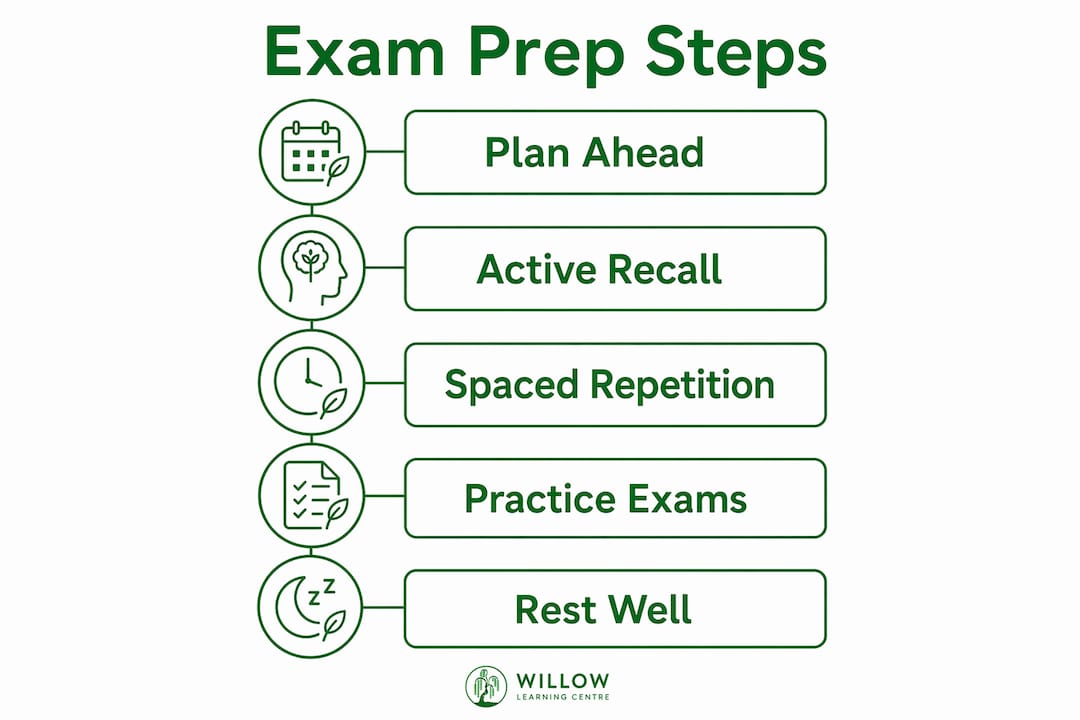
Which study techniques maximise retention?
Students using active recall and spaced repetition score 12–18% higher than peers who rely on passive review. That gap exists because passive methods like re-reading create a false sense of familiarity without building genuine retrieval ability.
Active recall means closing your notes and forcing yourself to retrieve information from memory. This could be answering practice questions, writing summaries from scratch, or using flashcard apps like Anki. The struggle to retrieve an answer is not a sign of failure. It is the mechanism through which memory is strengthened.
Spaced repetition works by reviewing material at increasing intervals, just before you would naturally forget it. The forgetting curve shows that knowledge fades rapidly without review. Revisiting content at the right moment rebuilds and extends retention each time. Spaced repetition increases long-term retention by up to 65% compared to cramming, which often results in near-total memory loss within days of the exam.
Effective test preparation techniques include:
- Flashcard self-testing using Anki or physical cards, reviewed daily in short sessions
- Past paper practice completed under timed conditions to build exam fluency
- Error logs where you record every mistake and revisit those topics specifically
- Teach-back method where you explain a concept aloud as if teaching someone else
Prioritising the hardest 20% of material where you make the most errors yields better results than reviewing content you already know well. Convert your past paper mistakes into Anki flashcards and review them focally. This turns errors into your most productive study resource.
Pro Tip: If a topic feels easy to re-read, that is a warning sign, not a green light. The fluency illusion tricks you into thinking you know material because it looks familiar. Test yourself instead.
How to structure productive study sessions
The quality of your study environment directly affects how much you retain. Sit at a clear desk, silence your phone, and use a tool like Forest or the Pomodoro Technique to protect your focus blocks. Background noise, social media notifications, and multitasking all reduce the depth of processing your brain can achieve.
Here is a reliable session structure that works across subjects:
- Review your error log for five minutes before starting. This primes your brain to focus on weak areas rather than comfortable ones.
- Study actively for 45–60 minutes using flashcards, practice questions, or written recall. No passive reading during this block.
- Take a ten-minute break away from screens. Walk, stretch, or have a snack.
- Spend the final ten minutes testing yourself on what you just covered, without looking at your notes.
Cramming is the single most common mistake students make. Cramming loads information into short-term memory and leads to rapid forgetting, often within 24–48 hours of the exam. It also increases anxiety, which further impairs recall on the day.
Sleep is not optional. Sleep deprivation before exams significantly impairs performance because sleep is when the brain consolidates learned information. Aim for 7–9 hours every night during your revision period, not just the night before. Nutrition and light exercise also support cognitive performance in ways that extra study hours cannot replicate.
Pro Tip: Practice exams under timed conditions do two things at once: they reveal exactly where your knowledge breaks down and they train your brain to perform under pressure. Do at least one full timed paper per subject before exam day.
How to manage exam day for your best performance
Exam day performance is largely determined by what you did in the weeks before. That said, how you approach the final 24 hours and the exam itself still matters.
The night before, do a light review of your summary notes or key flashcards. Do not attempt new material. Your brain needs consolidation time, not new input. Eat a proper meal, prepare everything you need for the morning, and get to bed at your normal time.
On exam day:
- Eat breakfast. Glucose supports concentration and recall during the exam.
- Arrive early. Rushing raises cortisol levels, which directly impairs memory retrieval.
- Use deep breathing if anxiety spikes before or during the exam. Four counts in, hold for four, out for four. This activates the parasympathetic nervous system and reduces the physical symptoms of stress.
- Answer easy questions first. Answering easy questions first can boost performance by around 8% by building momentum and freeing up time for harder questions.
- Eliminate wrong answers on multiple-choice questions before committing to your final choice.
Managing anxiety is a skill, not a personality trait. Students who build confidence through preparation report lower panic responses on exam day because their brain recognises the test format from practice. Preparation is the most reliable anxiety reducer available.
Key takeaways
Effective exam preparation requires starting early, using active recall and spaced repetition, and practising under real exam conditions rather than relying on passive review.
| Point | Details |
|---|---|
| Start with a timed plan | Begin 6–8 weeks before finals and map sessions by subject difficulty and exam date. |
| Use active recall daily | Test yourself with flashcards or past papers rather than re-reading notes. |
| Space your review sessions | Spaced repetition increases long-term retention by up to 65% compared to cramming. |
| Prioritise weak areas | Focus on the hardest 20% of material where your errors cluster for the greatest gains. |
| Protect sleep and recovery | Sleep consolidates learning; treat rest as part of your study plan, not a reward for finishing. |
What I have learned from watching students prepare
Most students I have worked with share one habit: they confuse time spent studying with progress made. They sit at a desk for three hours, re-read their notes, and feel productive. Then they sit a practice paper and are surprised by the result.
The shift that changes everything is moving from passive to active. Once a student starts testing themselves instead of reviewing, their confidence changes. Not because the material suddenly gets easier, but because they stop being surprised by what they do not know. They already found those gaps in practice.
Starting early is the other non-negotiable. Students who begin revision six to eight weeks out have time to revisit material multiple times. Those who start two weeks before are forced to cram, which feels productive but rarely translates to results.
The students who perform best are not always the most naturally able. They are the ones who treat preparation as a skill to be practised, who use their exam stress constructively, and who are honest with themselves about where their knowledge actually breaks down. That honesty, combined with the right methods, is what produces results.
— Fu Pincheng
How Willow Learning Centre @ Bedok supports your exam prep
Willow Learning Centre @ Bedok works with Primary, Secondary, and Junior College students across Singapore to build the study habits and subject knowledge that exams actually test. Classes are kept small so tutors can identify each student's specific weak areas and address them directly, rather than delivering the same lesson to everyone. Students receive guided practice with past papers, structured revision plans, and the kind of consistent feedback that turns errors into learning. If you want personalised support that goes beyond generic advice, visit Willow Learning Centre to find out how tailored tuition can make a real difference to your results.
FAQ
How far in advance should I start exam preparation?
Start 6–8 weeks before finals and 3–4 weeks before standard exams. This gives you enough time to use spaced repetition effectively rather than cramming.
What is the most effective study technique for exams?
Active recall and spaced repetition consistently outperform passive methods. Students using these techniques score 12–18% higher than those who rely on re-reading or highlighting.
How long should each study session be?
Study sessions of 45–90 minutes with short breaks produce the best results. Younger students benefit from shorter 25–50 minute blocks with deliberate rest between them.
Is cramming ever a useful last-minute exam tip?
Cramming loads information into short-term memory and leads to rapid forgetting, often within 24–48 hours. A focused review of key flashcards and summary notes the night before is far more effective.
How does sleep affect exam performance?
Sleep consolidates learned information and is critical for memory retrieval. Sleep deprivation before exams significantly impairs performance, making consistent rest a core part of any preparation plan.