
TL;DR:
- Effective revision pacing involves strategically timing study sessions to boost retention and reduce stress, especially for Singaporean students preparing for major exams. Methods like spaced repetition, the Pomodoro Technique, and interleaving improve study efficiency by encouraging focused, varied, and spaced review over an extended period. Building a flexible timetable and focusing on quality over quantity helps students achieve better results without burnout or unnecessary pressure.
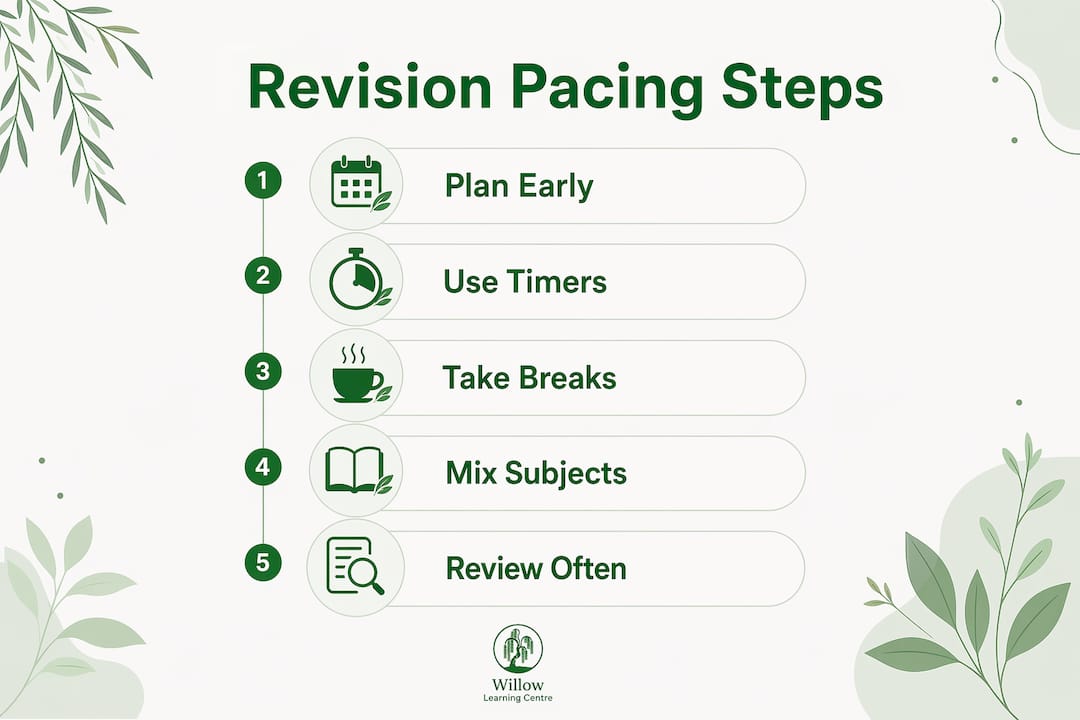
Revision pacing is the deliberate design of study sessions, timed and spaced to maximise learning efficiency and reduce stress. For students in Singapore preparing for O-Levels, A-Levels, or PSLE, poor pacing is one of the most common reasons capable students underperform. The good news is that revision pacing is a learnable skill. Methods like spaced repetition, the Pomodoro Technique, and interleaving give students a structured way to study smarter, not longer.
What is revision pacing and why does it matter?
Revision pacing is the strategic timing and organisation of study sessions to build retention without exhausting the brain. The term overlaps with what learning scientists call distributed practice, which is the deliberate spreading of study across time rather than concentrating it in one sitting.

Students who pace their revision correctly retain more, feel less overwhelmed, and perform better under exam conditions. Those who do not tend to cram, which degrades performance rather than improving it. The difference is not effort. It is timing.
How many hours per day should students revise?
The answer depends on the time of year. 1–3 hours of daily revision is appropriate during term time, rising to 4–6 hours per day during exam leave. That range matters because exceeding roughly 6 hours of deep work triggers cognitive burnout, where additional study produces no meaningful gain.
Here is a practical daily structure that works for most secondary and JC students:
-
Morning block (45–50 minutes). The brain is freshest after sleep. Use this time for your hardest subject or the topic you find most difficult. Take a 10–15 minute break before the next block.
-
Mid-morning block (25–45 minutes). Tackle a second subject. Avoid repeating the same topic from the morning block.
-
Afternoon block (25–45 minutes). Energy dips after lunch. Use lighter review tasks such as flashcards or past-paper MCQs rather than new material.
-
Evening block (25–45 minutes). Suitable for consolidation, writing practice, or reviewing notes from earlier in the day.
For intense subjects like Mathematics and Physics, the Pomodoro Technique works well. It uses 25-minute focused sessions followed by 5-minute breaks. After four sessions, take a longer 15–30 minute break to allow full recovery.
Pro Tip: Three hours of well-structured, broken-up study outperforms six hours of continuous unfocused revision. Quality of attention matters far more than total time spent at a desk.
What is spaced repetition and how does it pace revision?
Spaced repetition is a study method where you revisit material at increasing intervals over time, rather than reviewing it repeatedly in a single session. Each revisit strengthens the memory trace before it fades, making long-term retention far more reliable than cramming.
The evidence is clear. Students who use 4–5 cycles of spaced repetition improve long-term retention by up to 150% compared to massed practice. That figure explains why starting early is not just good advice. It is a structural requirement of effective revision.
Key points for applying spaced repetition in Singapore’s exam context:
-
Start at least 6 months before your exam. This gives you enough time to complete multiple review cycles across all subjects.
-
Shorter windows still work. A 2-month revision window can be effective if you focus on weak topics and past papers, though broad coverage suffers.
-
Space your review cycles. Review new material after 1 day, then 3 days, then 1 week, then 2 weeks. Adjust based on how well you recall each topic.
-
Use active recall within each cycle. Testing yourself, rather than re-reading notes, forces the brain to retrieve information, which is where real learning happens.
Active recall and spaced repetition are intentionally uncomfortable cognitive activities. The mental effort you feel during active study is not a sign of failure. It is a sign that your brain is building stronger neural pathways.
How does interleaving improve your study sessions?
Interleaving means mixing different subjects or problem types within a single study session, rather than spending the entire session on one topic. It feels harder in the moment, but the learning it produces is far more durable.
Research shows that interleaved practice improves delayed test performance by 43% compared to blocked topic practice. That is a substantial difference for students sitting high-stakes exams. The reason it works is that switching between subjects forces the brain to discriminate between concepts, which deepens understanding beyond simple repetition.
Practical ways to use interleaving in your revision:
-
Mix two or three subjects per session. For example, spend 25 minutes on Chemistry, then 25 minutes on English comprehension, then 25 minutes on Maths.
-
Return to each subject every 2–3 days. Revisiting subjects at this frequency builds memory more durably than reviewing the same topic daily.
-
Combine interleaving with active recall. After switching subjects, test yourself briefly on what you covered in the previous block before moving on.
-
Expect initial discomfort. Interleaving feels less productive at first because it is harder. That difficulty is precisely what makes it effective.
Pro Tip: If you find interleaving confusing at first, start by mixing just two subjects per session. Add a third only once you feel comfortable managing the mental shift between topics.
How to build a revision timetable that actually works
A well-paced timetable is built backwards from your exam dates and forwards from your current knowledge gaps. Follow these steps to create one that holds up under real exam pressure.
-
List all your exam dates. Write them in order and calculate how many weeks you have for each subject.
-
Audit your topics using a traffic-light system. Mark topics red (weak), amber (partial), or green (confident). Prioritise red topics in your earliest revision cycles.
-
Block focused study sessions. Assign specific subjects to specific time slots. Keep each block to 25–60 minutes and schedule breaks between them.
-
Build in buffer days. At least one day per week should be left open for catch-up or revisiting difficult topics. Buffer slots are essential for managing the unpredictability of student schedules.
-
Review your timetable weekly. Adjust based on what you have covered and where you are falling behind. Flexibility is not a weakness. It is good planning.
| Timetable Element | Recommended Approach |
|---|---|
| Daily study hours (term time) | 1–3 hours, split into focused blocks |
| Daily study hours (exam leave) | 4–6 hours maximum |
| Session length | 25–60 minutes per block |
| Break length | 5–15 minutes between blocks |
| Subject rotation | Every 2–3 days per subject |
| Buffer days | At least one per week |
Parents can support this process by helping students map out their exam schedule at the start of each term and checking in weekly, not daily, to avoid adding pressure. The goal is a plan the student owns, not one imposed from outside.
Key takeaways
Consistent, well-spaced revision sessions built around focused blocks, regular breaks, and subject mixing outperform long unstructured study every time.
| Point | Details |
|---|---|
| Daily hour limits matter | Revise 1–3 hours during term and 4–6 hours during exam leave to avoid burnout. |
| Session structure drives results | Use 25–60 minute focused blocks with 5–15 minute breaks for maximum retention. |
| Start spaced repetition early | Begin structured revision 6 months before exams to complete 4–5 learning cycles. |
| Interleaving beats blocked practice | Mixing subjects each session improves delayed test performance by 43%. |
| Buffer days protect your plan | Reserve one day per week for catch-up to keep your timetable realistic. |
What i have learnt coaching students through exam season
The single biggest mistake I see students make is planning for 8 hours of revision and actually producing 2 hours of focused work. True focused output rarely exceeds 3–5 hours daily, even for the most disciplined students. Planning beyond that does not create more learning. It creates guilt and exhaustion.
What actually works is accepting your real capacity and building a timetable around it. A student who revises for 3 honest hours a day, every day, for 6 months will outperform a student who plans for 8 hours and delivers 2. The maths is simple. The discipline is harder.
I also advocate strongly for personalised learning approaches over generic timetables. Every student has a different energy pattern, a different set of weak topics, and a different threshold for cognitive fatigue. A timetable copied from a friend is almost always wrong for you.
Parents, your role is to help your child build the plan, then step back and let them own it. Checking in once a week is supportive. Checking in daily is pressure. The difference matters more than most parents realise.
— Fu Pincheng
How Willow Learning Centre @ Bedok supports your revision plan
Building a revision timetable is one thing. Sticking to it, and knowing whether your study methods are actually working, is another challenge entirely.

At Willow Learning Centre @ Bedok, tutors work with each student to build a study plan that fits their exam schedule, subject strengths, and energy patterns. Small group classes mean students get direct feedback on their progress, not generic advice. Whether your child is preparing for PSLE, O-Levels, or A-Levels, the tutors at Willow Learning Centre @ Bedok have a proven track record of helping students reach their target grades. Explore how personalised tuition can support your child’s revision this year.
FAQ
How many hours a day should a student revise for o-levels?
During term time, 1–3 hours of daily revision is sufficient. During exam leave, students can increase to 4–6 hours per day, split into focused blocks with regular breaks.
When should students start revision for a-levels?
Starting at least 6 months before exams gives students enough time to complete 4–5 cycles of spaced repetition, which improves long-term retention by up to 150%.
What is the Pomodoro technique and does it work for revision?
The Pomodoro Technique uses 25-minute focused study sessions followed by 5-minute breaks. It is particularly effective for demanding subjects like Mathematics and Physics, where sustained concentration is required.
Is interleaving better than studying one subject at a time?
Yes. Interleaved practice, mixing subjects within a session, improves delayed test performance by 43% compared to studying one topic in a single block. It feels harder but produces stronger long-term memory.
How can parents help with revision pacing without adding pressure?
Parents can help by assisting with timetable planning at the start of term and reviewing progress once a week. Avoid daily check-ins, as these can increase anxiety rather than support focus.