
TL;DR:
- Building academic confidence requires deliberate retrieval practice, stress management, and engaging tasks within the Zone of Proximal Development to foster genuine growth.
- Students in Singapore often face self-imposed pressure that impairs learning; structural routines and help-seeking positively influence confidence and results.
Academic confidence is defined as a student's belief in their ability to understand, retain, and apply knowledge under pressure. For students in Singapore, building confidence in studies is not simply about feeling good before an exam. It requires deliberate techniques grounded in learning science, combined with strategies for managing the intense academic pressure that shapes student life here. This guide covers retrieval practice, stress management, and the Zone of Proximal Development (ZPD), three evidence-backed approaches that directly improve both academic self-esteem and results.
What study techniques most effectively build confidence?
Retrieval practice builds stronger retention than rereading notes, and this is one of the most replicated findings in cognitive psychology. Students who test themselves on material consistently outperform those who reread, even when rereading feels more comfortable and fluent. That feeling of fluency is the trap. It creates the illusion of knowledge without the substance.

The problem with passive rereading is that it rewards recognition, not recall. You recognise a formula when you see it, but that does not mean you can produce it under exam conditions. Retrieval practice builds genuine confidence because it forces you to reconstruct knowledge from memory, which is exactly what exams demand. Each successful retrieval attempt is direct evidence that you actually know the material.
Spaced repetition compounds this effect. Studying in short, focused blocks across several days produces far better retention than a single long session. Tools like Anki or self-made question banks make it straightforward to schedule these sessions systematically. The key is consistency over intensity.
- Write questions from your notes immediately after class, then answer them the next day without looking
- Use flashcards for definitions, formulas, and key concepts in subjects like Chemistry or Mathematics
- After completing a topic, close your notes and write down everything you remember before checking
Pro Tip: When you fail to recall something during retrieval practice, treat it as useful data, not failure. That gap is exactly what you needed to find. Mark it, revisit it the next day, and track how your success rate improves over time.
How does exam stress affect academic confidence in Singapore?
Singapore students face a specific and well-documented pressure pattern. Clinics report 12 to 15 new student patients monthly seeking help for exam stress, with psychologists noting that the pressure is increasingly self-driven rather than parent-imposed. Students compare themselves to peers, set punishing internal standards, and interpret any setback as evidence of inadequacy.
A 2026 study published in Frontiers in Psychology found a strong link between self-imposed academic pressure and serious mental health symptoms including depression, anxiety, and suicidal ideation among Singapore youth. This is not background noise. It is a direct threat to learning capacity and confidence. Stress at this level impairs working memory, disrupts sleep, and makes it harder to retain information.
Overcoming study anxiety requires both structural and psychological changes. Kansas State University's counselling research recommends reviewing material in small blocks over several days before tests, combined with deliberate stress-reduction techniques. The structural change is the study schedule. The psychological change is how you interpret difficulty.
- Replace "I don't understand this" with "I haven't understood this yet"
- Set one specific, measurable goal per study session rather than vague targets like "study Biology"
- Build a short relaxation routine before studying: five minutes of slow breathing genuinely reduces cortisol
- Prioritise seven to nine hours of sleep, particularly in the week before major assessments
Pro Tip: Break your revision into 25-minute focused blocks with a five-minute break between each. This approach, sometimes called the Pomodoro method, reduces the sense of overwhelm and creates a steady rhythm of small wins that shift your mindset from dread to progress.
What is the Zone of Proximal Development and why does it matter?
The Zone of Proximal Development, a concept developed by psychologist Lev Vygotsky, defines the space between what a student can do independently and what they can achieve with guidance. Tasks pitched within the ZPD promote confidence by balancing challenge with achievable support. Tasks that are too easy produce boredom and stagnation. Tasks that are too difficult produce anxiety and avoidance. Neither builds genuine academic self-esteem.
The practical implication is that confidence grows fastest when you are working at the edge of your current ability with the right support in place. This is why generic study advice often falls short. A student who struggles with Secondary 3 Additional Mathematics needs targeted scaffolding on specific gaps, not a general reminder to "study harder." Singapore's Ministry of Education recognises this, recommending small-group targeted academic support with customised resources for students who need structured intervention.
Seeking help is not a sign of weakness. Productive help-seeking correlates positively with both achievement and confidence. Understanding why personalised learning matters can help you make better decisions about the kind of support you pursue.
| Study task type | Effect on confidence |
|---|---|
| Too easy (below ability) | Builds boredom, not skill; confidence feels hollow |
| Within ZPD (with support) | Produces genuine growth and earned self-efficacy |
| Too difficult (without support) | Triggers anxiety and avoidance; erodes confidence |
How to build and maintain study confidence step by step
Confidence in studies is not a fixed trait. It fluctuates, and it can drop temporarily even when you are making real progress. Retrieval practice may briefly lower confidence when you fail to recall something, but this is a sign the method is working, not that you are failing. The goal is to measure confidence by your success rate on subsequent attempts, not by how easy studying feels in the moment.
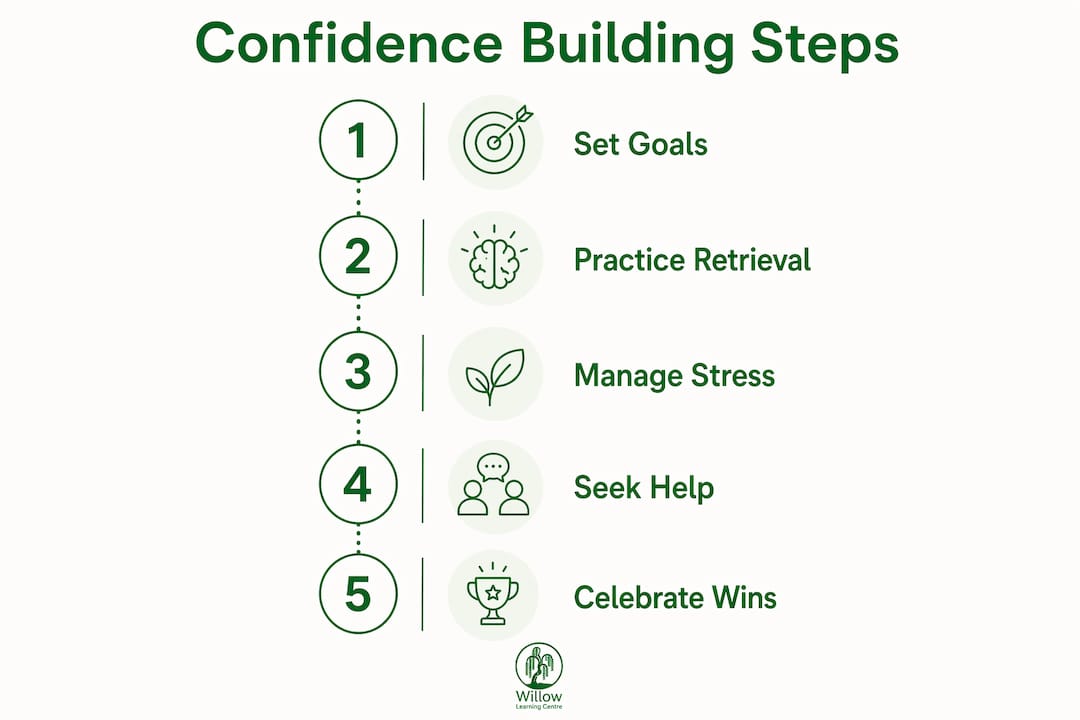
- Set specific, measurable goals. Before each session, write down exactly what you will cover and how you will test yourself on it. "Revise Chapter 4 and answer ten practice questions" beats "study Chemistry."
- Schedule retrieval sessions in advance. Block out short study periods across the week rather than leaving revision to the night before. A structured revision plan reduces last-minute uncertainty and the anxiety that comes with it.
- Incorporate a stress-reduction routine. Treat sleep, exercise, and brief relaxation practices as non-negotiable parts of your study plan, not optional extras.
- Use the ZPD to select tasks. If a topic feels impossible, seek help before frustration sets in. If it feels too easy, push to the next level of difficulty. Learning to ask teachers better questions accelerates this process considerably.
- Track your evidence of learning. Keep a simple log of topics you have tested yourself on and your success rate. Watching this improve over weeks is one of the most reliable ways to build lasting academic self-esteem.
Pro Tip: Celebrate small wins deliberately. After a successful retrieval session or a topic you finally understand, acknowledge it. This is not self-indulgence. It is how you train your brain to associate effort with progress rather than with stress.
Key takeaways
Building confidence in studies requires combining retrieval practice, structured anxiety management, and appropriately challenging tasks within your Zone of Proximal Development.
| Point | Details |
|---|---|
| Retrieval beats rereading | Testing yourself produces stronger retention and genuine confidence than passive review. |
| Stress management is non-negotiable | Self-driven pressure in Singapore students directly impairs learning; structured routines reduce this. |
| ZPD defines the confidence zone | Tasks pitched at the right challenge level with support produce the fastest confidence growth. |
| Confidence fluctuates normally | Temporary dips during retrieval practice are learning signals, not evidence of failure. |
| Help-seeking is a strength | Seeking targeted support correlates positively with both achievement and academic self-esteem. |
What I have learned from watching Singapore students struggle with confidence
I have worked with students across Primary, Secondary, and Junior College levels, and the pattern I see most often is not a lack of ability. It is a mismatch between how students study and what actually builds real confidence. Many students spend hours rereading notes and feel prepared, then freeze in the exam hall because they have never practised retrieving information under pressure. The fluency they felt while studying was not real knowledge. It was familiarity.
The second pattern I see is students who refuse to ask for help because they interpret needing help as proof they are not smart enough. This is the most damaging belief in Singapore's academic culture. Confidence is not the absence of difficulty. It is the accumulated evidence that you can work through difficulty. Every time you seek help, identify a gap, and then close it, you are building the kind of confidence that holds up under exam conditions.
The strategies in this article are not a one-time fix. They are habits. The students I have seen transform their results are not the ones who studied the most hours. They are the ones who studied with the right methods, managed their stress honestly, and asked for help when they needed it.
— Fu Pincheng
How Willow Learning Centre @ Bedok supports your confidence
Students who struggle with academic confidence often need more than good advice. They need a structured environment where the work is pitched at exactly the right level and a tutor who notices when they are stuck before frustration sets in.
Willow Learning Centre @ Bedok offers small-group tuition for Primary, Secondary, and Junior College students across Singapore. Classes are personalised to each student's learning gaps, applying the same ZPD principles discussed in this article. Tutors track progress session by session and adjust the challenge level accordingly. If you are ready to study smarter and build confidence that holds up when it counts, explore personalised tutoring at Willow and find the right fit for your needs.
FAQ
What is the most effective technique for building study confidence?
Retrieval practice, testing yourself on material rather than rereading it, is the most evidence-backed method. Students who use self-testing retain information better and build confidence grounded in actual recall ability.
Why do Singapore students experience such high exam anxiety?
Research shows that exam stress among Singapore students is increasingly self-driven, with clinics seeing up to 15 new student patients monthly. Fear of disappointing oneself or peers, rather than parents, is now the primary driver.
How does the Zone of Proximal Development help with confidence?
The ZPD identifies the learning zone where tasks are challenging but achievable with support. Working within this zone produces genuine skill growth and self-efficacy, whereas tasks that are too hard or too easy both stall confidence development.
Should I avoid retrieval practice if it makes me feel less confident?
No. A temporary drop in confidence during retrieval practice is normal and expected. It signals that you have found a real gap in your knowledge, which is exactly what you need to address before the exam.
How long does it take to build genuine academic confidence?
Confidence builds gradually through repeated successful retrieval attempts and consistent study routines. Most students notice meaningful improvement within three to four weeks of applying spaced retrieval practice alongside structured stress management.