
TL;DR:
- Recognizing early signs like prolonged homework and repeated confusion helps students seek timely academic support. Seeking help at least one week before deadlines improves outcomes, confidence, and emotional well-being. Proactive study assistance enhances success rates, reduces anxiety, and fosters resilience, especially when supported by structured tutoring partnerships.
Knowing when to get help for studies means recognising specific academic and behavioural signals that indicate your current approach is no longer working. Academic support, the formal term for tutoring, counselling, and advising services, is not a last resort. It is a deliberate strategy that produces measurable results. Students who used tutoring services achieved 7% higher overall success rates and 13% higher success in STEM subjects. That gap is significant enough to change a grade boundary, a school placement, or a university offer.
When to get help for studies: the clearest signs
The most reliable indicators of needing study help are not dramatic. They are quiet patterns that build over weeks. Recognising them early is the difference between a targeted fix and a full-scale academic crisis.
Academic indicators to watch for:
-
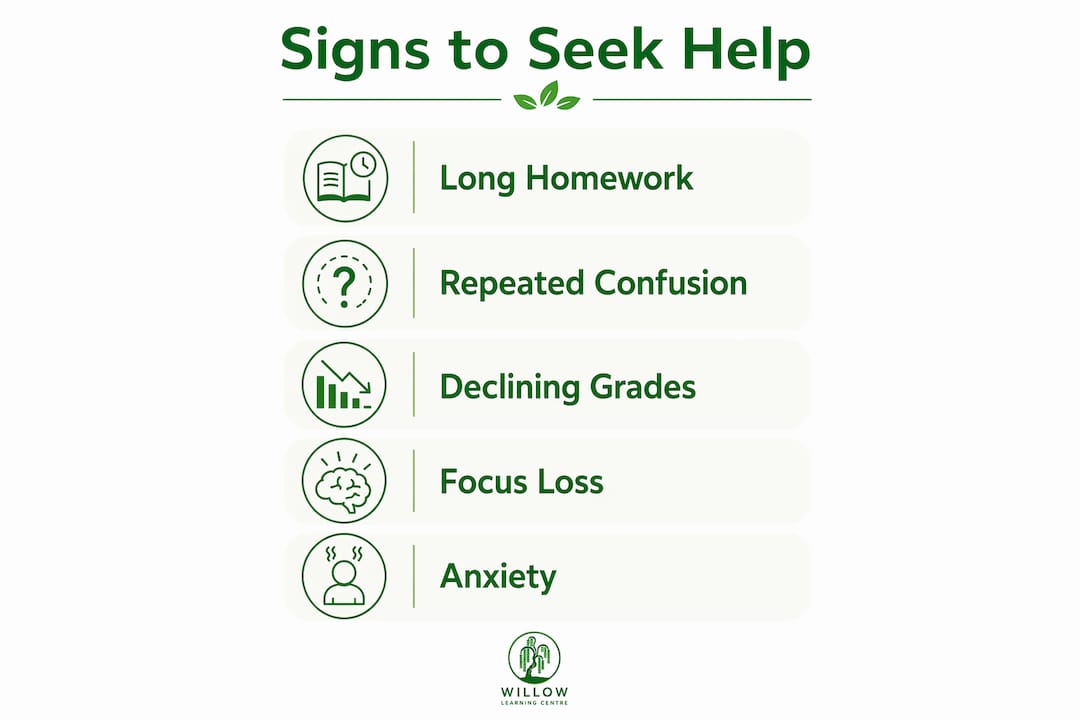
Homework that takes 2 to 3 times longer than it should. A task that once took one hour now takes three, with little improvement in quality.
-
Repeated confusion about the same concept after re-reading notes or watching revision videos.
-
Grades that remain flat or decline despite genuine effort and additional study time.
-
Consistently leaving assignments until the last two days, which misses the window for meaningful feedback and revision.
-
Avoidance of specific subjects, skipping revision sessions, or making excuses to delay starting work.
Behavioural and emotional indicators:
-
Visible frustration, tearfulness, or anger after study sessions.
-
Anxiety about upcoming tests that feels disproportionate to the difficulty level.
-
Withdrawal from friends or family, particularly around exam periods.
-
Loss of confidence in subjects the student previously enjoyed.
These signs of study struggles rarely appear in isolation. When two or more are present consistently over two to three weeks, that is a clear signal to seek academic assistance rather than wait for results to confirm the problem.
Pro Tip: Phone notifications cost an average of 23 minutes of refocus time per interruption. If a student’s study sessions feel unproductive despite long hours, removing the phone from the room entirely is the single fastest fix before any other support is arranged.
How does seeking academic support improve student outcomes?
The evidence for early academic intervention is direct and consistent. Students who access support proactively, rather than as crisis management, perform better and stay in education longer.
Institutions with strong learning support services see 90% of first-year students intending to return the following year, compared to 80% at institutions with minimal support. That 10-percentage-point gap reflects not just grades but confidence, belonging, and motivation.
“Asking for help builds resilience and fosters a sense of academic community belonging.” This matters especially in Singapore’s high-pressure academic environment, where students often internalise struggle as personal failure rather than a solvable problem.
Beyond grades, timely support reduces the anxiety that actively impairs learning. A student who understands the material feels calmer in exams, reads questions more carefully, and retrieves information more reliably. The academic and emotional benefits compound each other.
| Outcome | With early support | Without early support |
|---|---|---|
| Overall success rate | 7% higher | Baseline |
| STEM subject success | 13% higher | Baseline |
| First-year retention intent | 90% | 80% |
| Anxiety during exams | Reduced | Elevated |

Seeking help is not a sign of weakness. Educators consistently identify effective help-seeking as a mark of strong academic judgement, not inadequacy.
What types of academic help are available in Singapore?
Singapore students have access to a wider range of academic support than most realise. The challenge is knowing which type fits the specific problem.
Types of support and their best use cases:
| Type of support | Best suited for |
|---|---|
| Small group tuition centres | Consistent subject gaps, exam preparation, structured revision |
| Academic advising | Course selection, study planning, managing workload |
| School counselling | Anxiety, motivation issues, emotional barriers to learning |
| Writing support services | Essay structure, argumentation, language accuracy |
| Disability and accessibility services | Formal accommodations for diagnosed learning differences |
For students with diagnosed learning differences, accommodations must be arranged before the semester begins. Retroactive arrangements are rarely possible, so early registration is critical. Resources such as guidance on test accommodations for students with disabilities can help families understand what is available and how to apply.
When it comes to timing, seek assignment help at least one week before a deadline. This gives enough time to absorb feedback, revise work, and ask follow-up questions. Students who wait until two days before submission gain almost no benefit from the interaction.
Pro Tip: When approaching a tutor or teacher for the first time, bring a specific question rather than a general complaint. “I don’t understand Chapter 5” is hard to address. “I understand the formula but I get the wrong answer on questions involving two variables” gives the tutor a precise starting point.
How can parents recognise when their child needs academic help?
Parents often notice the signs of study struggles before the student acknowledges them. The key is knowing which signals are worth acting on immediately.
Watch for these indicators at home:
-
Homework sessions that regularly extend well beyond the expected duration, particularly if the student is visibly distressed rather than simply thorough.
-
Avoidance of a specific subject, including reluctance to open that textbook or complete that homework first.
-
A drop in self-confidence about school, expressed as “I’m just bad at maths” or “I’ll never understand this.”
-
Emotional withdrawal around exam periods, including reduced appetite, disrupted sleep, or irritability.
-
Grades that plateau or fall despite the student reporting that they studied hard.
When these patterns appear, the most effective response is a calm, curious conversation rather than an immediate problem-solving session. Ask what part of the subject feels confusing rather than why the grade dropped. This distinction matters because it shifts the focus from judgement to understanding.
Early action before grades decline is far more effective than waiting for a report card to confirm the problem. Partnering with a trusted tutoring centre, such as Willow Learning Centre @ Bedok, gives parents a structured way to support their child without the tension that can arise from home tutoring by a family member.
What stops students from asking for help, and how to overcome it?
The most common barrier to seeking academic assistance is not lack of access. It is mindset. Many students hold a do-it-yourself attitude that frames asking for help as evidence of failure. This belief is both widespread and demonstrably counterproductive.
A second barrier is high-effort, low-benefit study habits, such as copying notes verbatim or re-reading the same chapter repeatedly without testing recall. These habits feel productive but produce little retention. An academic advisor or tutor can identify these patterns quickly and replace them with methods that actually work.
“Tutoring and office hours are most effective when accessed proactively, not as crisis management.” Waiting until the week before the O-Level or A-Level examinations to seek help leaves no time for the feedback cycle that produces real improvement.
Practical steps to shift the mindset include normalising support use by talking about it openly, framing tutoring as preparation rather than remediation, and focusing on the specific skill being developed rather than the grade being chased. Asking for help builds academic resilience, which is a skill that transfers well beyond school.
Key takeaways
Recognising the signs you need study help early and acting within days, not weeks, is the single most effective way to prevent a small gap from becoming a serious academic setback.
| Point | Details |
|---|---|
| Act on early warning signs | Homework taking 2 to 3 times longer and repeated confusion are reliable early indicators. |
| Timing of support matters | Seek help at least one week before deadlines to allow meaningful feedback and revision. |
| Evidence supports intervention | Students using tutoring achieve 7% higher overall success and 13% higher STEM success. |
| Mindset is the main barrier | Viewing help-seeking as strength, not weakness, is the first step to accessing support. |
| Parents play a key role | Calm, early conversations and proactive tutoring partnerships prevent grade decline. |
Why I stopped waiting for students to ask
I have worked with students across Secondary, and Junior College levels for long enough to see the same pattern repeat. The students who struggle most are rarely those with the weakest ability. They are the ones who waited too long. By the time they arrive, they have spent months reinforcing the wrong understanding, and undoing that takes far more time than early support would have required.
What strikes me most is the emotional cost of delayed help-seeking. Students who have been quietly struggling for a term often carry a level of shame that makes learning harder, not easier. They second-guess every answer. They disengage in class to avoid being wrong publicly. Reversing that takes patience and consistency, both of which are easier to provide when the gap is still small.
My advice to parents is straightforward: do not wait for the report card. If your child is spending three hours on homework that should take one, or if they have stopped talking about school altogether, that is your signal. Act on it now, not next term.
— Fu Pincheng
Get the right support at Willow Learning Centre @ Bedok
Willow Learning Centre @ Bedok offers small group tuition classes for Primary, Secondary, and Junior College students across Singapore. Classes are personalised to each student’s individual learning needs, which means tutors address the specific gaps holding your child back rather than delivering a generic syllabus. The centre’s tutors have a proven track record of helping students achieve excellent grades. If the signs in this article sound familiar, the most useful next step is to explore what structured, personalised support looks like for your child. Visit Willow Learning Centre to find out more about available classes and enrolment.
FAQ
What are the first signs a student needs study help?
Homework taking 2 to 3 times longer than expected, repeated confusion about the same concepts, and declining grades despite genuine effort are the clearest early indicators. Emotional signs such as frustration after study sessions or anxiety about specific subjects are equally important to notice.
When should a student seek academic assistance?
Seek support as soon as two or more warning signs appear consistently over two to three weeks. For assignment-specific help, approach a tutor or teacher at least one week before the deadline to allow time for feedback and revision.
Is tutoring a sign of academic failure?
Tutoring is a mark of good academic judgement, not failure. Students who use tutoring services achieve measurably higher success rates, and educators consistently identify proactive help-seeking as a strength rather than a weakness.
How can parents support a child who is struggling academically?
Start with a calm, specific conversation focused on which part of the subject feels confusing rather than why the grade dropped. Partner with a trusted tutoring centre early, before grades decline, to provide structured support without the tension that home tutoring can sometimes create.
Do students with learning differences need to arrange support in advance?
Accommodations for diagnosed learning differences must be registered before the semester begins. Retroactive arrangements are rarely available, so families should contact the relevant support services as early as possible, ideally before the academic year starts.