
TL;DR:
- Effective chemistry revision relies on active problem-solving, spaced repetition, and creating condensed summaries. Practising recall with past papers and understanding examiner language enhances exam performance and confidence. Consistent targeted practice and metacognitive awareness lead to long-term mastery over short-term memorization.
Effective chemistry exam revision is defined by three pillars: conceptual understanding, active problem-solving, and spaced repetition. Passive rereading of notes does not build the pattern recognition that O-Level and N-Level chemistry papers demand. The students who score well are those who practise actively and recall often, not those who highlight the most. This guide gives you a clear, structured approach to chemistry exam preparation, built specifically for secondary school students in Singapore sitting MOE-aligned syllabuses.
What tools do you need for chemistry revision?
The right materials cut wasted time. Before you start any revision session, gather these resources.
- Syllabus document: Download the MOE Chemistry syllabus from the SEAB website. Every topic you revise must map to a syllabus point. If it is not in the syllabus, it will not be tested.
- Textbook and class notes: Use these for initial concept understanding, not for revision. Revision means testing yourself, not rereading.
- Past papers and mark schemes: These are your most important tools. Past papers show you exactly what examiners ask. Mark schemes show you exactly how marks are awarded.
- Flashcard apps: Apps like Anki use spaced repetition algorithms to schedule your reviews automatically. This removes the guesswork from deciding what to revise.
- Mind maps and flowcharts: Draw these by hand for topics like the reactivity series, acid reactions, and organic chemistry. The act of drawing forces your brain to organise information.
- AI flashcard tools: Platforms like Revaldo AI can generate flashcards from your notes, saving time on card creation so you can spend more time on actual recall practice.
Pro Tip: Download the mark scheme alongside every past paper you attempt. Read the mark scheme before you check your answers. Study the language it uses, then attempt the paper. This trains you to write in the exact style examiners reward.
| Resource | Best Used For |
|---|---|
| Past papers | Practising exam technique and timing |
| Mark schemes | Learning examiner language and credit criteria |
| Anki flashcards | Daily vocabulary and equation recall |
| Mind maps | Summarising reaction pathways and topic links |
| Syllabus document | Checking revision coverage and topic weighting |
How do active recall and spaced repetition improve retention?
Active recall and spaced repetition are the two most research-supported study techniques available to you. Used together, they replace cramming with genuine long-term memory.
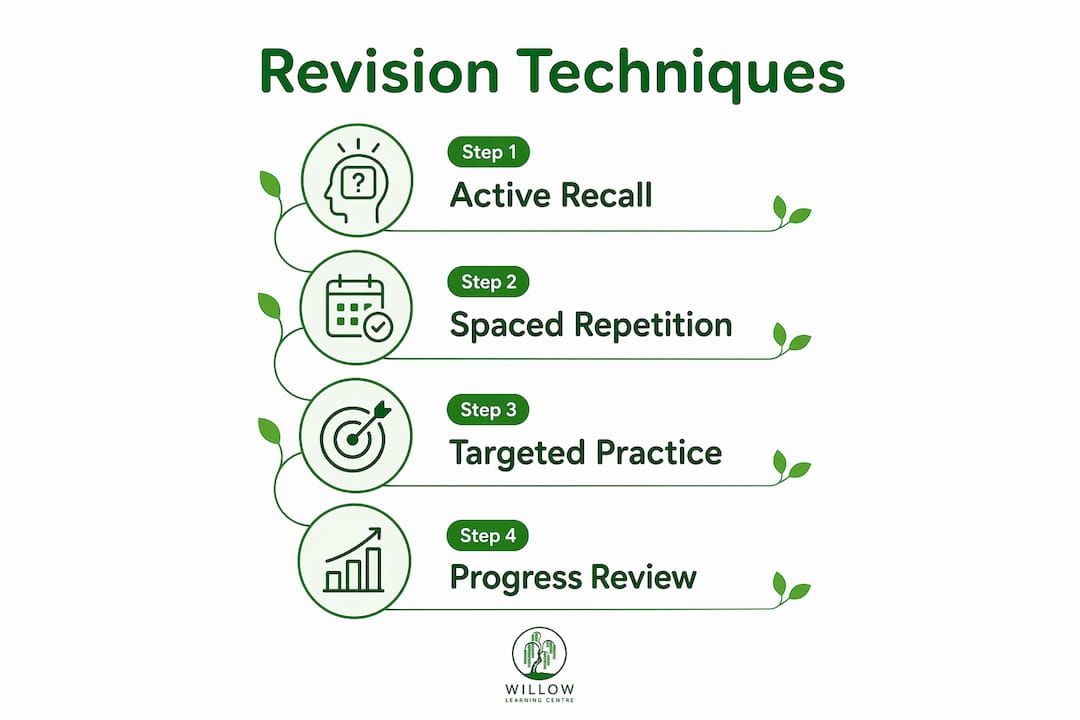
Active recall means retrieving information from memory without looking at your notes. The blurt technique is one of the most direct ways to do this. Set a timer for five minutes, write down everything you know about a topic, then check your notes to find the gaps. The blurt technique exposes knowledge gaps quickly and without stress. It feels uncomfortable at first, which is exactly the point. Discomfort means your brain is working.
Spaced repetition solves the forgetting curve. Your memory of a new concept drops sharply within 24 hours unless you review it. Reviewing topics at intervals of 2 days, 1 week, and 1 month significantly improves long-term retention. This is why cramming the night before an exam produces poor results. The information never has time to consolidate.
Here is how to apply both techniques to chemistry:
- After each lesson, spend 10 minutes writing down everything you recall without opening your book.
- Use Anki to schedule spaced reviews of definitions, equations, and reaction conditions.
- Test yourself on past paper questions from a topic before you feel ready. Struggling to retrieve an answer strengthens memory more than reviewing notes does.
- Teach a concept aloud to an imaginary student. If you cannot explain it simply, you do not understand it yet.
Pro Tip: Create a "not yet" pile of Anki cards for concepts you keep getting wrong. Review this pile every single day until the cards move to your "known" pile. This targeted repetition is far more efficient than reviewing everything equally.
How should you structure your practice problem sessions?
Structured practice sessions build the speed and flexibility that chemistry exams require. Random, unplanned practice does not.

Solving 15–20 practice problems per session is the recommended volume for reinforcing understanding and building exam speed. That number is specific for a reason. Too few problems and you do not build fluency. Too many and concentration drops, making errors more likely.
Follow this sequence for each practice session:
- Choose a single topic, such as moles and stoichiometry or electrolysis.
- Attempt 15–20 questions from past papers on that topic only.
- Mark your work using the mark scheme. Note every mark you lost and why.
- Categorise your errors by type, not by question. For example, group errors as "stoichiometry calculation errors," "definition too vague," or "missed unit conversion." This reveals the underlying weakness, not just the wrong answer.
- Revisit the relevant concept in your notes or textbook, then attempt two or three similar questions immediately.
Two common mistakes to avoid:
| Mistake | Why It Hurts | Better Approach |
|---|---|---|
| Doing full papers too early | Switching topics causes cognitive fatigue and masks specific weaknesses | Do topic-focused practice first; save full papers for the final weeks |
| Repeating the same question type | Builds false confidence without flexible thinking | Interleave varied problem types across each session |
Mark schemes also contain language worth studying closely. Words like "allow," "ignore," and "reject" in a mark scheme tell you precisely how strict the examiner is on wording. Understanding mark scheme keywords is one of the fastest ways to pick up marks you are currently losing without knowing it. Pair this approach with guidance from the IB exam-style questions practice workflow for additional structure on building problem-solving speed.
What are the best ways to summarise core chemistry concepts?
Summarising is not copying. A good summary forces you to compress and reorganise information, which itself is a form of active recall.
One-page summary sheets for each topic are one of the most effective revision tools you can create. Each sheet should contain key definitions, important equations, common mistakes you have made, and one worked example. Keep them to one side of A4. The constraint forces you to prioritise what matters most.
For reaction mechanisms and multi-step processes, flowcharts outperform linear notes. Draw the steps of a reaction sequence as a flow diagram, with arrows showing what each reagent does. Learning the mechanism before memorising products builds stronger, more flexible knowledge. When you understand why a reaction produces a certain product, you can work out unfamiliar reactions in the exam rather than relying on memory alone.
Pro Tip: Build a "concept roadmap" for each major topic. Start with the central idea in the middle of a blank page and draw branches for every related concept, equation, and exception. This visual structure helps you see connections between topics, which is exactly what higher-order exam questions test.
Common pitfalls to avoid when summarising large chapters:
- Do not copy full paragraphs from your textbook. Paraphrase in your own words.
- Do not leave diagrams unlabelled. Every diagram should have annotations explaining what is happening.
- Do not summarise a topic you have not yet tested yourself on. Summarise after recall practice, not before.
Key takeaways
Effective chemistry revision combines active recall, spaced repetition, and targeted practice to build lasting understanding rather than short-term memory.
| Point | Details |
|---|---|
| Practise actively, not passively | Use the blurt technique and past paper questions to test recall instead of rereading notes. |
| Space your reviews deliberately | Review new topics after 2 days, 1 week, and 1 month to prevent forgetting. |
| Structure each practice session | Attempt 15–20 problems per topic, then categorise errors by type to find real weaknesses. |
| Summarise to consolidate | Create one-page topic sheets with key formulas, definitions, and your own common mistakes. |
| Use mark schemes as a teaching tool | Study examiner language to understand exactly how credit is awarded and lost. |
Why metacognition is the skill most students overlook
Most students I work with focus entirely on what to study. The ones who improve fastest also ask how they are studying. That shift in thinking is called metacognition, and it changes everything.
Metacognition/01%3A_Laying_the_Groundwork_for_Chem_101/1.03%3A_How_to_Succeed_in_Chem_101_(or_any_course_for_that_matter)) means monitoring your own understanding in real time. After a practice session, ask yourself: "Did I actually understand that, or did I just follow a procedure?" If you cannot explain a concept without your notes, you do not own it yet. Teaching it aloud to someone else, or even to yourself, is the fastest test of genuine mastery.
The students who struggle most are those who confuse familiarity with understanding. Reading your notes until they feel familiar is not revision. It is comfort. Real revision feels difficult because it is. Embrace the mistakes you make in practice. Each wrong answer is a signal, not a failure. It tells you exactly where to focus next.
Consistent, spaced study across several weeks will always outperform a frantic weekend of cramming. If you are feeling overwhelmed by exam pressure, the student guide to managing exam stress offers practical strategies to keep your revision sustainable.
— Fu Pincheng
How willow learning centre @ bedok supports your chemistry revision
Self-study is powerful, but personalised guidance accelerates progress significantly. Willow Learning Centre @ Bedok offers small group tuition classes designed specifically for secondary school students in Singapore, with sessions tailored to each student's individual learning needs and syllabus requirements.

Our tutors have a proven track record of helping students achieve excellent grades by combining the evidence-based techniques in this guide with targeted feedback on each student's specific weaknesses. Whether you need help structuring your revision schedule, working through difficult topics, or building exam technique, personalised chemistry tuition at Willow Learning Centre @ Bedok gives you the support to move from uncertain to confident. Speak to us today about how we can strengthen your chemistry exam preparation.
FAQ
What is the most effective way to revise chemistry?
Active recall and spaced repetition are the most effective revision methods for chemistry. Test yourself on topics without looking at notes, then review at increasing intervals to build long-term retention.
How many practice problems should i do per session?
Aim for 15–20 practice problems per session, focused on a single topic. This volume builds fluency and speed without causing concentration to drop.
Should i do full past papers straight away?
Topic-focused practice is recommended before attempting full papers. Full papers too early cause cognitive fatigue and can mask specific knowledge gaps that need targeted work.
How do i use a mark scheme effectively?
Study the mark scheme language, particularly words like "allow," "ignore," and "reject," to understand exactly how marks are awarded. This tells you how precise your wording needs to be.
How do i ask better questions during chemistry lessons?
Prepare specific questions about concepts you could not explain during self-testing. The guide to asking better questions in class offers a practical framework for getting more from every lesson.